Tag Archives: Architecture

The Gang’s All Here

Well, they were, anyway. In June of this year, members of The Menokin Project design team traveled to the Northern Neck for a planning meeting.

In attendance were the architects from Machado and Silvetti, the cultural landscape historians from Reed Hilderbrand, and members of the Menokin staff and board of trustees.

We were treated to a wonderful dinner at King Copsico Farm, the home of Helen and Tayloe Murphy, which is situated on a gorgeous bluff overlooking the Potomac River.

Left to Right:
Jose Ribera – Project Manager/Machado & Silvetti
Rodolpho Machado – Principal/Machado & Silvetti
Jorge Silvetti – Principal/Machado & Silvetti
Leslie Rennolds – Assistant Director/Menokin Foundation
Tayloe Murphy – Board President/Menokin Foundation
Alan Brown – Consultant for Reed Hilderbrand
Michael Yusem – Senior Associate/Machado & Silvetti
Sarah Pope – Executive Director/Menokin Foundation
Ryan Ives – Reed Hilderbrand
Penelope Saffer – Trustee/Menokin Foundation
John Grove – Reed Hilderbrand
Helen Murphy – Trustee/Menokin Foundation
A view of the Potomac River from King Copsico Farm.

Field Trip: The Menokin Girls Head to D.C.

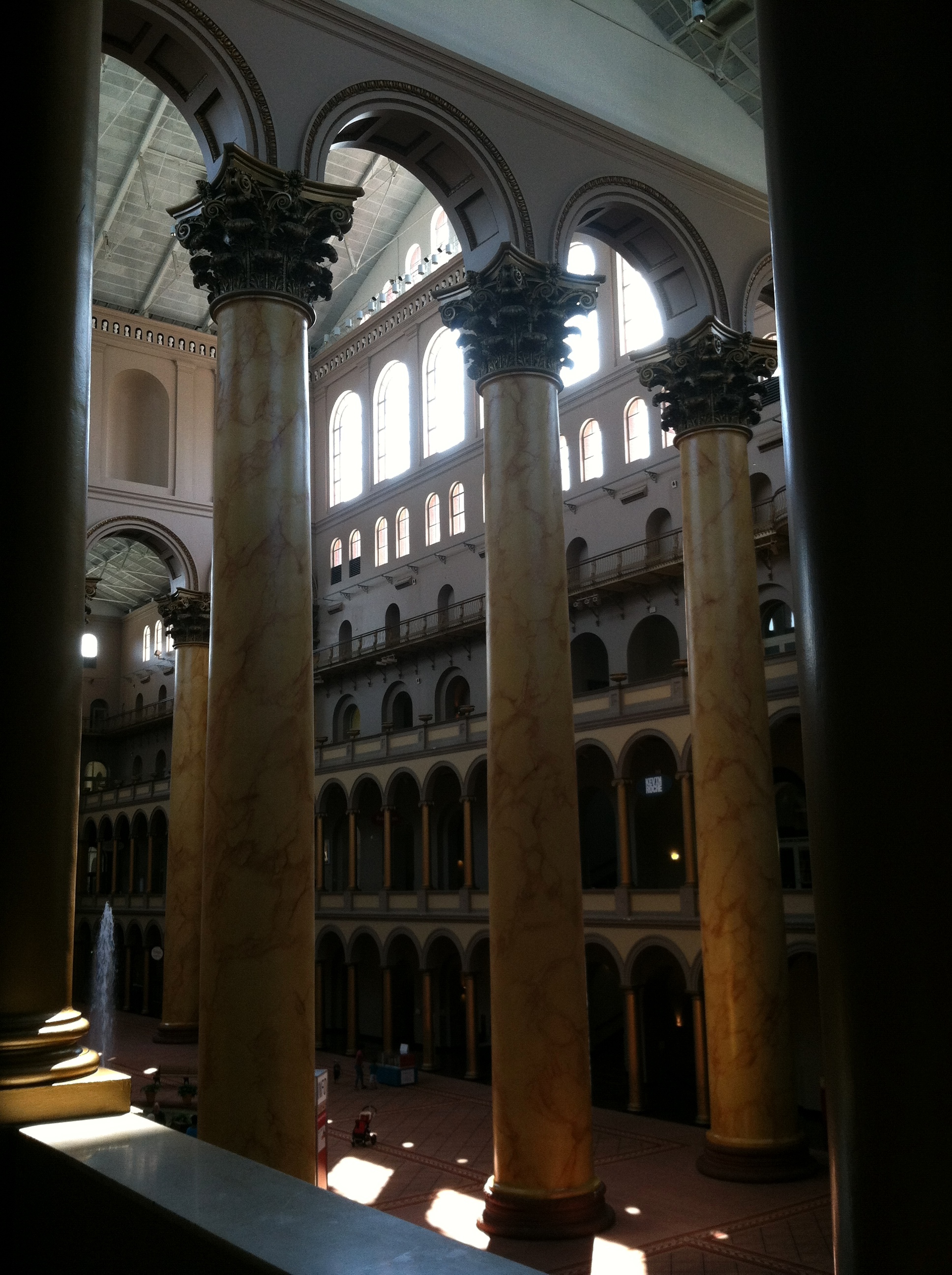
Last week the Menokin Staff took a field trip into Washington, DC. The primary reason for our trip was to visit the National Building Museum. Our goal was to research their exhibits and come away with ideas for our Visitor’s Center and collection.

If you’ve never been to the National Building Museum, you might drive right past it. Looking suspiciously like a federal administration building, it was, in fact, constructed between 1882 and 1887,  for the purpose of serving as a fireproof headquarters of the U.S. Pension Bureau’s headquarters. In 1997, the historic building was officially renamed the National Building Museum.

However, it is anything but ordinary.

The interior of the building is dominated by a grand central space, the Great Hall. Measuring 116 x 316 feet, the Great Hall features a central fountain and is divided into three courts by two screens of four colossal Corinthian columns—among the tallest classical columns in the world.

As hard as it was to drag ourselves away from the grandeur of the Great Hall, our first stop, the House & Home Exhibit, was well worth it. This “kaleidoscopic array of photographs, objects, models, and films that takes us on a tour of houses both familiar and surprising, through past and present, challenging our ideas about what it means to be at home in America.” We came away from the exhibit with brains churning with ideas of how to use and display our unique collection of construction artifacts here at Menokin.

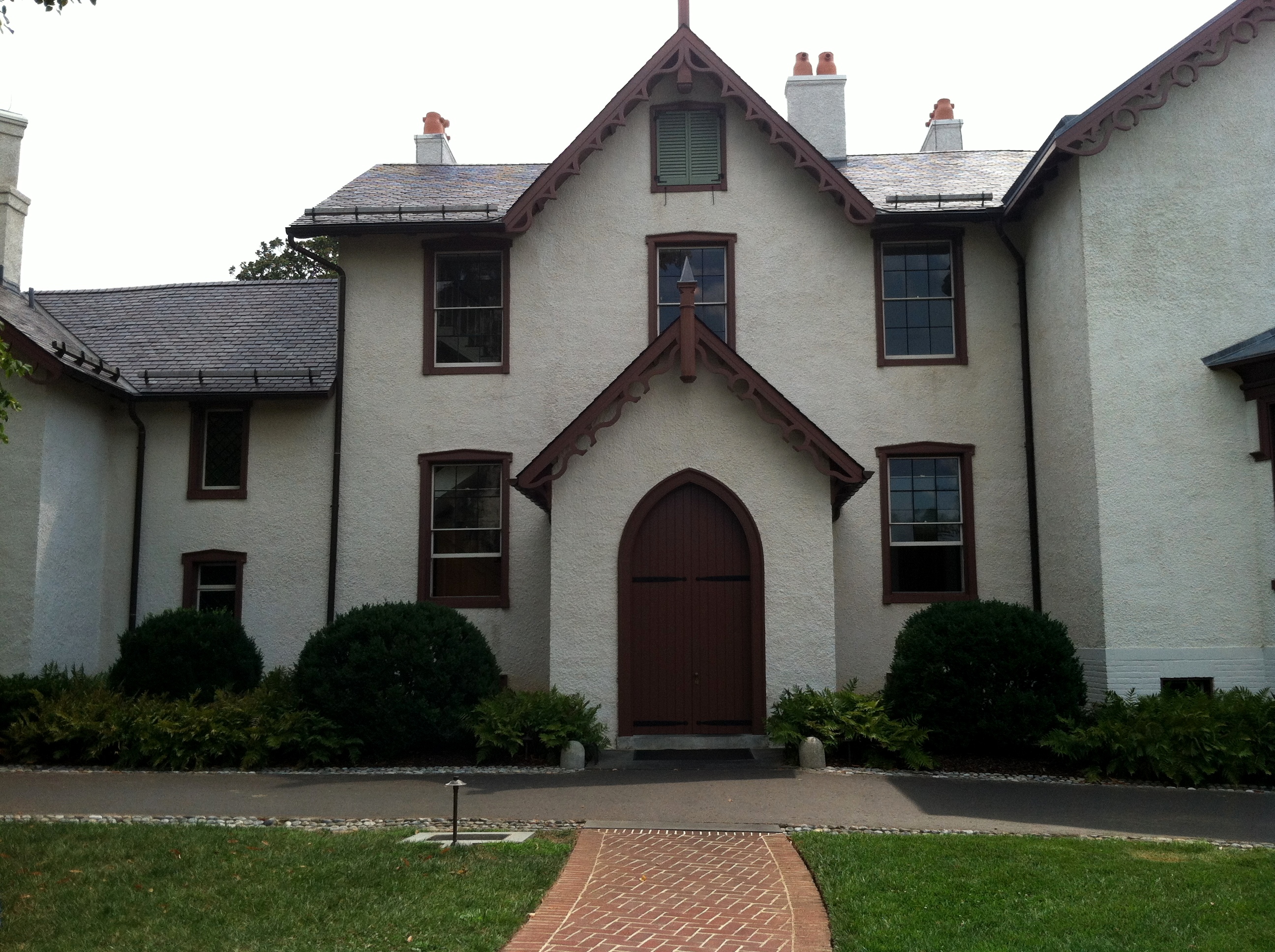
After a quick lunch in Chinatown (just a few blocks away), we headed up to President Lincoln’s Cottage at the Soldier’s Home three miles north of downtown. Founded in 1851 as a home for retired and disabled veterans of American wars, the Soldiers’ Home stands on 276 acres atop the third highest area in the District of Columbia.

The tour focuses largely on the time that Lincoln spent at the Cottage during his presidency. The story is told by a tour guide in a friendly, conversational manor, with lots of questions directed at the audience.  The house itself is very stark. Little or no furnishings occupy the large rooms. There is not a great sense of the people that lived there, but the use of recorded actors recounting stories, reading letters and holding conversations in each room does lend insight to the kind of life that the Lincolns had there.

Both places are well worth the visit.

Keep Out

Window panes from a door of an abandoned blacksmith shop near Menokin.

Photos by Leslie Rennolds
Assistant Director, Menokin

“A Place Like No Other.”

Commentator Thea Marshall recently learned about a famous architect who’ll be putting back together again a famous pile of rubble.

Of course, the famous architect is Jorge Silvetti – of Machado and Silvetti Associates – and the famous pile of rubble is Menokin, a National Historic Landmark and the Commonwealth’s largest and most historic jigsaw puzzle.

This essay, as comfortable to listen to as a favorite tune, is chock full of information about Menokin – the place, the people who lived here, and what the future holds for this historic treasure.

http://ideastations.org/radio/archive/2012-07-25-menokin-redux

Thea Marshall is the author of “Neck Tales: Stories from Virginia’s Northern Neck,” published in June, 2009. Along with her professional writing assignments, she is a broadcaster, actor, and producer, with life long experience in all forms of communication – from print to theater to radio and television. She writes and broadcasts original commentaries on and about the people, places, history, culture and current issues relating to the Northern Neck for WCVE Public Radio (heard on both WCVE in Richmond and WCNV for the Northern Neck).

Menokin Is Calling To Your Camera

Don’t forget that the Menokin Photography contest is now underway. Even an overcast day can result in gorgeous pictures. These were all taken right here at the Visitor’s Center.


Olympic Port Competition Entry / Machado and Silvetti Associates

The architecture firm of Machado and Silvetti – team leader for the Menokin Project – came in fourth place with this submission for the 2016 Olympic Port.

They are always Gold with us.

…………………………………………………………………………………………………………………

See more at Arch Daily.

Machado and Silvetti Associates  shared with us their entry for the Olympic Port Competition that came in fourth place. This project proposal for the 2016 Olympic Media Village in  includes housing for 11,000 people, retail and office space, a 5-star hotel and a convention center. To accommodate post-Olympic marketing of the buildings the entire residential and office program has the capacity to be transformed from a hotel setting with individually accessed bedrooms and private baths to two- and three-bedroom apartments and leasable tenant space.

Localism and Place Identity

This quote from The Actual Proposal struck a chord with me. It seems to aptly illustrate the lifestyle of the Northern Neck – that of the Lees and Tayloes, and even of the residents today.

Image of Menokin from the Robert A Lancaster Collection Circa 1880

In the daze of overwhelming mobility perhaps architects should wonder: what’s wrong with standing still?  Poet, essayist, and farmer, Wendell E. Berry, shares a similar sentiment in remembering his grandfather:

“My grandfather, on the contrary, and despite his life’s persistent theme of hardship, took a great and present delight in the modest good that was at hand: in his place and his affection for it, in its pastures, animals, and crops, in favourable weather.

He did not participate in the least in what we call “mobility.” He died, after eighty-two years, in the same spot he was born in. He was probably in his sixties when he made the one longish trip of his life. He went with my father southward across Kentucky and into Tennessee. On their return, my father asked him what he thought of their journey. He replied: “Well, sir, I’ve looked with all the eyes I’ve got, and I wouldn’t trade the field behind my barn for every inch I’ve seen.”

In such modest joy in a modest holding is the promise of a stable, democratic society, a promise not to be found in “mobility”: our forlorn modern progress toward something indefinitely, and often unrealizably, better. A principled dissatisfaction with whatever one has promises nothing or worse.”

Calling All Photographers.

The Menokin Foundation invites you to visit our site and show us Menokin through your lens. This photo contest includes three categories: Wildlife, Landscape and Architecture. The contest will conclude in November with a salon style exhibit and reception at the Menokin Visitor’s Center.

At least three images from each category will be printed, framed and displayed at the exhibit. All other works entered will be displayed in a slide show.

The show will be judged by Richmond photographer, Hullihen Williams Moore, who studied with Ansel Adams. The University of Virginia Press published a book of Hullie’s images, Shenandoah: Views of Our National Park, and his work is part of the permanent collection of the Virginia Museum of Fine Arts.

AUGUST 1st: Entry submission begins

OCTOBER 15th: Entry deadline

NOVEMBER 2: Exhibition and reception

Rules and Guidelines: (Delivery information is listed at bottom of page)

1) All photos must be submitted digitally no later than midnight of October 15, 2012.

2) Emailed photos must not be larger than 3MB. Larger files will be accepted on CD or DVD via mail and hand delivery.

3) Only three images per applicant will be accepted. They may be in any category of your choosing: Wildlife, Landscape or Architecture.

4) Registrants must complete an application and submit with their entries. Applications are available at the Visitor’s Center in Warsaw and on our website. (http://www.menokin.org/pdf/events/Photo%20Contest%20Flyer.pdf )

5) Prizes will be awarded as follows: 1st, 2nd and 3rd prize in each category and one Best In Show. A prize will also be awarded to the Best In Show winner – an afternoon of photography at Menokin with Hullie Moore.

Menokin is located at 4037 Menokin Road in Warsaw, VA. Call us at 804-333-1776, visit online at menokin.org, or email us at menokin@menokin.org.

Tobacco Rolling Roads

There is much evidence at Menokin of human impact on the land. The example below demonstrates that there were tobacco rolling roads on the Menokin plantation. These roads allowed for barrels filled with tobacco to be easily transported to the river. After these barrels were rolled down these roads to Cat Point Creek, they were shipped off to be sold in various markets.


These tobacco rolling roads were built to hasten the process of transporting tobacco and further the success of the plantation.  The enslaved men and women at Menokin most likely dug these roads, evidence of which you now see today.

The landscape holds traces of history everywhere. These rolling roads demonstrate that the actions of people centuries ago are still with us today. Even though the forest looks wild, upon closer look you can see the imprint of Frank’s decisions and the labor of slaves.

These tobacco rolling roads helped advance the commercial interests of Menokin. Can you see how people use land today to enhance one’s business? What other ways do people impact and distort the land?

Trees of Menokin

Are you sad the cherry blossoms are no longer in bloom? Do you still need that tree fix?! At Menokin, there are an abundance of tree species to see. In fact, you can download our tree guide and learn about over 30 species of trees while enjoying a nice walk on our nature trail. Bring some friends and your dog and experience these natural wonders!

First, let’s test your tree knowledge! Do you know what tree this is? (Hint: it is the Virginia state tree)

It’s a flowering dogwood tree (Cornus Florida)! Actually, the white or pink “flowers” of the flowing dogwood tree are bracts, or specialized leaves, that surround a cluster of tiny yellowish flowers. The dogwood tree is beautiful all year round.  The white or pink “flowers” that bloom in the spring give way to bright, red leaves in the fall. The flowering dogwood is abundant in the Eastern United States. [1]

Can you name this tree?

It’s a Tulip Poplar (Liriodendron Tulipfera)! The tulip poplar is one of the largest of the native trees to the Eastern seaboard. Native Americans and colonists used these trees to make canoes.  It could be that the Rappahannocks, who lived on Cat Point Creek, could have used some of Menokin’s tulip poplars to build some canoes! [2]

Another tree you can see at Menokin is a Devil’s Walkingstick. Can you tell us how this tree got such a spooky name?!

——
Notes:
[1] “State Trees and State Flowers,” The United States National Arboretum
[2] “Tulip-tree, Tuliptree Magnolia, Tulip Poplar, Yellow Poplar,” The Floral Genome Project