Category Archives: The Landscape

Botanical Survey Reveals Uncommon Orchid at Menokin

Excitement was high last week when, at the end of a day of surveying flora in the woods at Menokin, the master naturalists came in to report that they had found what they suspected to be a fairly uncommon orchid growing in the woods.

Master Naturalist Earline Dickinson contacted local botany expert, Ellis Squires, to see if he could make a visit to Menokin to confirm their speculation. The two of them arrived early the following morning, ready to take the trek down the trail to see the orchid.

I decided to tag along and take some pictures. I don’t know if you’ve ever taken a walk through the woods with two botanists. Here’s how it goes. You walk about five feet and then you stop while they identify five varieties of fern, spout out Latin and common names, other sites where these plants have been sighted and friendly explanations of why they are what they are, grow where they grow and are called what they are called so us “non-botanists” don’t feel left out. It was fascinating. I loved every minute of it.

About thirty species later we arrived at the place where the orchid had been found. Sure enough, there it was, nestled in the brown leaves, being as delicate and 009green and purpley-pink as it could in this unusually cool spring weather. Ellis confirmed immediately that we indeed have the uncommon Galearis spectabilis – or Showy Orchis – growing in the woods at Menokin. This plant is fairly uncommon in the area, so the find was a good one.

Also known as the purple-hooded orchis, the flowers are hooded and the namesake of the plant due to the showy, typically bicolored lavender and white 009_croppedflowers. The lavender hood is formed from three fused sepals. Two petals are tucked inside the hood and the labellum (third petal) is longer and white. Plants are slow growing and will form clumps overtime via crown offshoots from the rhizome.

The Showy Orchis is not the only uncommon plant identified that day. Check back for more posts about the other unique and interesting flora that make their home at Menokin.


Eruditionem ilex.

Here are three things I learned this past Saturday:

1. The Latin word for holly is ilex.
2. There are whole societies of people who are organized around their love and knowledge of genus ilex.
3. These Holly Society people are fun!

web_004I learned all of these things because the Colonial Virginia Chapter of the Holly Society of America held their meeting at Menokin on Saturday.

The Holly Society of America, Inc. is an active, non-profit organization with members throughout the United States and numerous foreign countries. The purpose of the Society is to stimulate interest, promote research, and collect and disseminate information about the genus Ilex. The society provides the medium for all people interested in hollies, including both novices and skilled growers, to communicate and exchange information through scientific studies, publications, lectures, meetings, visiting holly collections, and other educational endeavors.

I have to admit that I had no idea what to expect, but definitely not who showed up. The front line of organizers swarmed in and within minutes transformed the Menokin Visitor’s Center into Holly Central. There was a table for holly clippings, a table for FOOD (lots and lots of food), a table for books about holly, and a table for fern (yes, fern – go figure) samples for the day’s lecture.


There was also a patio full of beautiful potted plants for the auction that concluded the activities. The proceeds from the auction are earmarked to send a well-deserving 5th grader from Gloucester to Nature Camp. As a former Nature Camper myself, I threw in a winning bid for a pair (male and female) of
Ilex verticillata “Chrysocarpa” (yellow-fruited winterberry) bushes.


The members of the Colonial Virginia Chapter came from all over – many from Tidewater, some from the Northern Neck, a few from Maryland, and two visitors from Ohio. All were new to Menokin and enjoyed hearing about our programs and plans.

By the end of the meeting I felt as if I was bidding farewell to old friends.


Here’s What Geocachers Are Saying About Menokin

Geocaching_logoI have read about this place. Never knew I would make it here. Thanks so much! Awesome place and enjoyed the walk and history!


Geocaching_logoMenokin was definitely on our to-do list. It was better than we anticipated. We had the muggle-free run of the place.


Geocaching_logoI finally made it down to Menokin. I have been wanting to visit this site for some time now. Nice location.


Geocaching_logoI’ve seen these caches on my maps for many months and glad to finally get here. This area is nothing like I imagined.


Geocaching_logoIt was difficult to find a cache for this county that didn’t take us completely out of our way. But reading this cache description, we knew this would be the perfect place to stop. We checked out the visitors center as well, and found the volunteer to be extremely helpful and friendly. We are already planning a return trip.


Geocaching_logoI am having a great time walking the grounds here.


Tree Huggers at Menokin

The Northern Neck Chapter of Master Naturalists are conducting a flora and fauna survey of Menokin as part of the Chesapeake Bay Gateways Grant from the  National Park Service that was received in 2012.

The purpose of these volunteers is to help Menokin prepare trails/areas for viewing sheds and soft kayak/canoe public access sites. In addition, the survey will provide information for:

  • designing content for maps, guides and on-line resources
  • researching best alternatives for piers and viewing stations
  • locating and identifying native plants and restoring native habitat displaced during the construction process

In return, these volunteers will receive:

  • practice in the roles, taxonomy, and identification of native plants in Virginia
  • an understanding of living shorelines
  • volunteer hours
  • great walks in the out of doors

A recent team of volunteers shared some photos of their work measuring beech trees in the woods along the nature trail.

A botanical survey of Menokin prepared by Lise Maring, Northern Neck Chapter of the Master Naturalists, is available on our website. Scroll to the bottom of the Selected Articles and Books section and click on the link.

.

A gobble, gobble here and a gobble, gobble there.

Writing from France on January 26, 1784 to his daughter Sally (Mrs. Sarah Bache) in Philadelphia, Benjamin Franklin shared his thoughts on the wild turkeys in America.

For the Truth the Turkey is in Comparison a much more respectable Bird, and withal a true original Native of America… He is besides, though a little vain & silly, a Bird of Courage, and would not hesitate to attack a Grenadier of the British Guards who should presume to invade his Farm Yard with a red Coat on.

The Virginia Department of Game and Inland Fisheries has these facts to share about this elusive bird. Those pictured here are residents of Menokin, and have been sporting about the property quite a bit in the last few weeks — no doubt spurred on by the rising sap and surging hormones.

  • Courtship begins in late March and early April. Egg laying commences around mid-April and peak of nest incubation is normally the first week of May (May 5). Hatching takes place 28 days later, normally during the first week of June.
  • Acorns are favored foods. Unlike deer, wild turkeys have a poor sense of smell and taste and they normally select acorns based on their size and shape. In contrast, white-tailed deer normally select white oaks because of their lower tannin content and less bitter taste.
  • Oak crops have a significant impact on fall turkey harvests. The harvest declines in years with good mast crops as flocks move less and typically stay in forested areas making them more difficult to locate and hunt. Conversely, during mast failures birds move further in search of food and typically are seen in fields and clearings making them more vulnerable to hunting and predation.
  • Wild turkey beards grow throughout the life of the bird and usually gain about 4 inches annually. Juvenile males or “Jakes” normally have a beard that is about 2-4 inches in length by their first spring gobbler season. Adult males or “Toms” commonly sport beards that are 8-12 inches in length. The overall length of the beard is regulated by wear as the beard drags the ground.
  • Hens can have beards and on rare occasions they have spurs. The Department estimates that about 5% of some local turkey female populations have beards. The occurrence of spurs is extremely rare however.
  • Spurs have a bony core and are covered with a keratinous material similar to our fingernails. Spurs grow throughout the life of the bird and can be used to estimate age.
  • The appearance of wild turkeys is the result of black, white, and brown feathers. Occasionally there are variations in feathers that result in color aberrations. “Smokey gray” birds lack any brown feather coloration and have been described as ghost-like in appearance. Red phase or eruythsite birds have red coloration in their feathers instead of brown. Occasionally we find melanistic birds that all black in color. In contrast, albinos are all white.
  • Virginia’s wild turkey population is estimated to be approximately 180,000 birds. Populations are not uniform across the state however as the highest population densities can be found in the Tidewater, South Mountain, and South Piedmont regions.
  • Weights of spring gobblers normally range from 17-19 pounds in Virginia.
  • Peak gobbling in Virginia would normally take place in early May based on gobbling surveys taken before we started spring gobbler hunting. Peak gobbling typically would coincide with peak nest incubation. However, gobbling rates decline as the spring season progresses because of harvests and reduce gobbling due to hunting pressure.

Hope Springs as a Daffodil

Just when you think you can’t stand one more, gray, damp, dreary day of February, the hardy daffodil pops up to save the day.

web_photo-(7)

The woods at Menokin are resplendent with the paint daubs of yellow that are splattered among the leaf litter on the forest floor. They grow in clumps that are spread like a stream along a bed known only to them.

There is debate about when these harbingers of spring were first brought to Colonial America. There are many accounts of a wide variety of narcissus bulbs being cultured and coveted in the early days of our country.

The variety we have here is known as Narcissus pseudonarcissus L. – daffodil. and the USDA credits them as being a native plant to Virginia as well as 26 other states.

naps_001_lvd
USDA-NRCS PLANTS Database / Britton, N.L., and A. Brown. 1913. An illustrated flora of the northern United States, Canada and the British Possessions. 3 vols. Charles Scribner’s Sons, New York. Vol. 1: 532.

All I know is that when you need a late winter boost of spirit, gazing into a bouquet of daffodils is just what the doctor ordered.

web_photo-(4)


Menokin Photo Contest Reception Was A Picture Perfect Evening.

Menokin staff, trustees, friends and photo contest participants gathered on a dark Friday evening to enjoy the results of the first ever Menokin Photography Contest.

Participants gathered from as far away as Gloucester and Northern Virginia to view the winning entries judged by Hullihen (Hullie) Williams Moore. Photos from three categories – architecture, landscape and wildlife – were judged on composition, quality and creativity. Each category was beautifully represented with winners as follows:

Check back later in the week for a slide show of the reception.

Our next photo contest will be announced soon.

Menokin: Education, Exploration, Enrichment – Day One

These words describe the very soul of Menokin’s mission. They represent all that Menokin has to offer, and when they are followed up by “A 500-acre classroom for heritage and natural resource conservation,” you can really get a picture of what goes on in this peaceful corner of the world.

Our mission was really put to the test this week, as Menokin played host to three different field trip groups from area schools. Each school represented a different age group and learning environment. But one thing was abundantly evident with all three. Kids love to learn, they love to explore, and they love to play.

DAY ONE – Tueday, November 6th
Aylett Country Day School, Millers Tavern, VA

Aylett is a small, private school in Essex County, VA, which is across the river from Richmond County, Menokin’s home. The school serves children from Preschool through the 8th grade. Students from Aylett come from many surrounding counties, including Essex, Richmond, King and Queen, King William and Middlesex.

The 8th-grade class visited Menokin on Tuesday. While they toured the visitor’s center, the conservation barn and the house site, the main purpose for their visit was to complete a community service project for Menokin. Armed with cans of orange spray paint, which managed to stay off the students, they hiked through the woods at Menokin with staff members Sarah Pope, Alice French and myself, marking the otherwise not-so-obvious path along the bluff overlooking Menokin Bay on Cat Point Creek.

A stop along the way introduced them to Thane Harpole of DATA Investigations, and his team of archaeologists conducting a survey here in conjunction with the Chesapeake Gateways Grant secured by Menokin earlier this year. The hike concluded with gathering water samples from Cat Point Creek and returning to the Visitor’s Center to test the water for oxygen and acidity levels.

The last few minutes before leaving were well used exploring 21st century  uses for colonial toys.

Slithering hither and yon

Northern Neck Master Naturalist John Narney was in the Menokin woods last week, working on a flora and fauna survey for the Chesapeake Bay Gateways Grant.

He encountered some fauna alright. Of the reptilian persuasion. Luckily he had his camera handy and shared these shots with me.

Eastern Rat snake (formerly called a Black Snake)
“When green is all there is to be
It could make you wonder why, but why wonder why
Wonder, I am green and it’ll do fine, it’s beautiful
And I think it’s what I want to be.”
~ Kermit The Frog
This narrow green snake was over two feet long.

No wild weather for this year’s “Go Wild” event

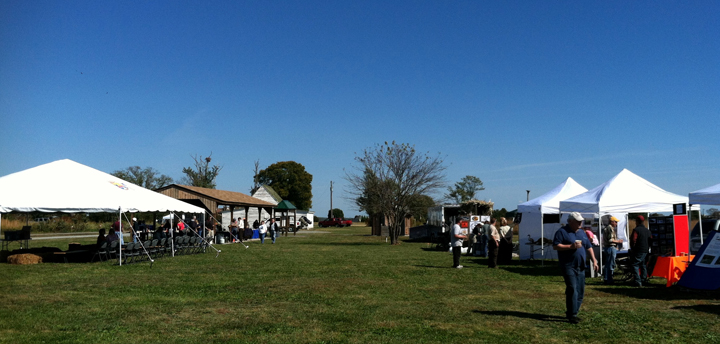
Yesterday was the 2nd annual “Go Wild” event at the Rappahannock River Valley National Wildlife Refuge’s Hutchinson Tract in Essex County, VA.

After the cold, windy, rainy day that greeted last year’s eventers, the clear blue October sky and 75+ degree temperatures were a welcome change.

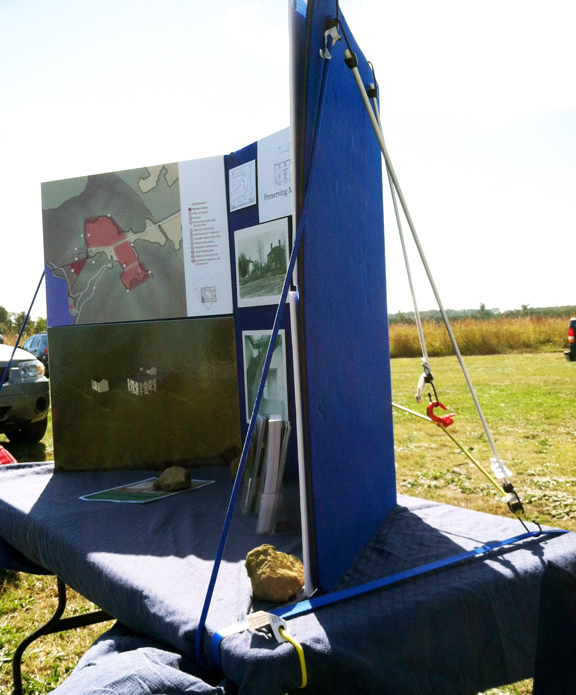
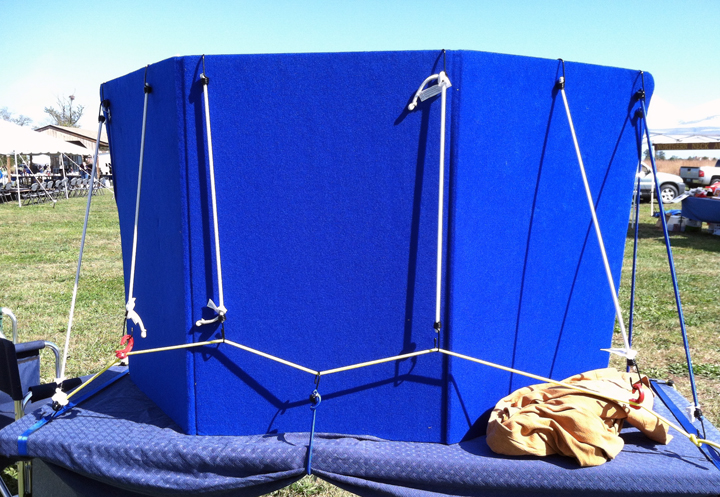
The wind still  had a few tricks up her sleeve, however,  and there were examples of human ingenuity all over the place as exhibitors tried to hold down tents, brochures and displays. My husband Ben, the master of all things rigged, “Bengineered” this bungee bracing system to keep the Menokin display board upright and in place.

I was there representing Menokin, and informing visitors about our nature trails and waterfront on Cat Point Creek, and explaining that 300 of our 500 acres are, in fact, part of the refuge.

There were all kinds of exhibitors on hand – from Native Plants Societies, Master Naturalist and Oyster Gardeners, to bluebird house building, reforestation surveyors and wildlife rehabilitation experts.

Our booth was next door to The Wildlife Center of Virginia, where their educator and handler, Rayna, brought out a series of rehabilitated birds to share with the public. You can find out these birds stories on their website.

Grayson, a broad-winged hawk, gave me the stare down.
Edie, an American Kestrel, is very comfortable with humans.

The Raptor Society of Virginia was also on hand with a few of their birds. This little screech owl won me over with her big green eyes and haughty, knowing air.

Fire, an Eastern screech owl

Congressman Rob Whitman spoke briefly, after being introduced by Refuge Administrator Andy Hoffman and RRVNWR Friends President, Anne Graziano.

Rob Whitman addressed the crowd
Andy Hoffman and Anne Graziano both spoke