The window in my office frames a beautiful view of Menokin. The native plants and shrubs around the visitor’s center bring me a constant and varied cast of feathered guests.
There are the regulars – Eastern bluebirds, goldfinches, hummingbirds, vireos. I more than occasionally spot wild turkeys and bald eagles grazing and hunting in the fields beyond the yard. Some rarer appearances have been made by migrating songbirds – scarlet and summer tanagers, rose-breasted grosbeaks and orioles.
What I don’t see – and this may come as a surprise to you – are pigeons. We just don’t have them in these parts. Doves, yes. Pigeons, not so much.
So imagine my surprise when a movement outside my window caught my eye recently and I looked out to see a pigeon pecking in the mulch under my window.
“Odd,” I thought. “That looks like a pigeon.”
Just then, a board member, stopping in for a meeting, came through the front door and asked if we were keeping pigeons as pets. “There’s a tagged pigeon wandering around right outside,” he said. “Does he belong to one of you?”
And, because of the aforementioned scarcity of pigeons, and the fact that we are The Intrepid Menokin Ladies, we leapt into action. Well, Mavora did. After heading outside to see the pigeon for herself, she made a call to a local wildlife rescue service to report in.
“Oh, that’s probably a racing pigeon,” she was informed. “They’re very used to being around people. Just take a box outside and he’ll walk right into it. Then bring him to us and we’ll take it from there.”
Wrong. The pigeon, while not apparently alarmed by our proximity (by this time, I had joined the adventure), kept a healthy and stealthy distance from any semblance of cardboard and/or would-be captors. At one point he even flew up onto the barn roof, alleviating our fears that perhaps he was injured.
We ditched the box idea and came back inside. By now it had been a few hours since the discovery of the pigeon’s arrival and we figured he was probably hungry and thirsty. We grabbed a box of Cream of Wheat and filled a bowl of water and went out to tend our flock of one. After hunting around we finally found him roosting in the lean-to on some of the large dress stones from the house (it must be a pigeon thing). He seemed mildly annoyed that we had discovered his hideout, but did allow Mavora to eventually get close enough to read the letters and numbers on the tag on his leg.
Leaving him to his meal we went back inside and did what all ingenious preservationists and conservationists do – we googled “Lost Racing Pigeons.” Bingo. Up came the website with all kinds of information about racing pigeons. I garnered a brief but thorough educational insight into the sport, then wrote down the phone number and gave it a call.
I don’t know why I expected the person who answered to be amazed that we had a misplaced racing pigeon. She wasn’t. It was probably her 168th missing pigeon report of the day. Upon entering our pigeon’s tag information into her database, she was able to tell us (in a voice reserved for reading the ingredients on a Cream of Wheat box) where the pigeon was from (Maryland), which club he belonged to, and the name and phone number of the club’s president.
I was in awe that there is a whole PIGEON NETWORK out there, flying all around us, that I had never been aware of until then. It inspired me to go outside and sit with the pigeon, who continued to keep a safe distance, and tell him all about Menokin and the Northern Neck.
After awhile he fell asleep and I went home. The next day he was gone. We never got a call back from the club president. It was probably his 168th “we have your pigeon message” of the week. We are certain that our pigeon made his way back to Maryland and told all of the other racing pigeons about the crazy ladies at his last stop who chased him with a box and fed him breakfast cereal. All that fuss over a pigeon?
emily lyth has been an intern at menokin since april 2014. she lives in richmond county with her family and is currently pursuing her bachelor’s degree from drexel university’s online degree program.
“I started visiting the trails at Menokin back in April. As a new intern, I felt it was important to educate myself about The Menokin Foundation. To me, that meant going beyond simply learning about Francis Lightfoot Lee and the history of the Menokin house; I wanted to explore the land and the property that are such an intrinsic part of Menokin’s story.
So when the weather got a little warmer, I laced up my hiking shoes, charged my iPod, and spent most of my Saturday traveling the beautiful paths through the woods and along Cat Point Creek. Though I hadn’t anticipated it, that was the beginning of a new weekend tradition for me ─ one that has become a great source of relaxation in my life.
The following weekend, I added my camera, some homework, and a book to my backpack and spent the afternoon taking pictures of nature and the wildlife, catching up on homework, and reading.
Whether it’s just to walk and mess around with my camera while I listen to music or to sit at the picnic table by the creek and do homework and read, spending time at Menokin is now something I look forward to after a long or stressful week; the whole property offers a peaceful solitude that can’t be found anywhere else.
Over the last couple of months, I’ve learned that visiting Menokin with friends is a fun way to spend the day enjoying nature, and visiting alone is a great way to relax, de-stress, and clear my mind. Menokin has become like my own little sanctuary ─ the place I escape to when I need time alone or need to unwind.
Since I started interning at Menokin, I have felt that I’m part of an organization and experience that is truly special, and I think the property and trails are a great reflection of that feeling.”
Internpretations are blog posts authored by our interns. this glimpse of menokin and its place in the lives of these college students is our attempt to represent an alternative point of view ofa menokin experience. the only instructions are “write about your experience here.” we hope to feature an internpretation each week.
This Eight-spotted Forester Moth (Alypia octomaculata) was feasting on the flowering winterberry bush outside my office window. Those puffy orange knees caught my eye and I had to go out to investigate.
The first few photo attempts were fruitless, as the moth flitted away as soon as I got close enough. Persistence paid off, however, and this flashy fellow got used to me and let me snap away.
First google search of “black and white moth with orange legs” hit the jackpot with enough information to make you a virtual Eight-spotted Forester Moth Expert.
Here are the tidbits that I found most interesting:
The EsFM is a smallish (1 ½ inch wingspread), flashy, day-flying moth that is often mistaken for a butterfly when it’s nectaring on flowers. While not knobbed like a butterfly’s, its antennae are slim (simple), not feathery. It has black wings with two cream-colored spots on each forewing and two white spots on each hind wing (= 8). Its body and legs are also black, accented by yellow “epaulets” called tegulae on the thorax at the base of each wing and by startling tufts of orange hairs at the tops of its first and second pairs of legs. One theory is that the orange tufts resemble the packed pollen baskets of a bee.
Their body and wings are black, there are two yellow spots on each forewing and two white spots on each hindwing….and of course those gorgeous orange tufts on their legs, that seriously look like stockings. The eight distinctive spots on their wings is where their species name comes from….octomaculata literally translates into 8-spotted.
The moth flies from April to June in one generation in the north. In the south it has a second generation, which flies in August.
A few other flying friends were at the party. This lightening bug seemed to think that the winterberry blossoms tasted just fine.
Menokin played host recently to the Virginia State Chapter of the Wheelin’ Sportsmen (VAWS). Our 500-acre property and handicap-accessible Visitor’s Center were a perfect fit for this intrepid and good-humored gang of hunters.
The Volunteer State Coordinator of VAWS, Robin Clark, along with local sportsman and volunteer, Ford Becker, coordinated the event which brought this group to Menokin to take advantage of the last day of turkey season and the opening day of deer season in early November.
VAWS is the largest and most active Wheelin’ Sportsmen program in the country, with roughly 400 members and over 35 annual events statewide. These events are open to anyone with a disability and there is no charge to participate. VAWS is part of the National Turkey and Wildlife Federation’s (NTWF) Hunting Heritage Programs.
Wheelin’ Sportsmen was designed to provide all people with disabilities the opportunities to enjoy the outdoors. Participants gain a sense of independence by learning to stay active in the outdoors. Event participants can enjoy activities like hunting, fishing and shooting. In addition to local chapter events, Wheelin’ Sportsmen hosts an assortment of other national events.
The Menokin Foundation was pleased to make our property available for these hunters.
If you have a disability, or have a friend or family member with a disability, and would like to participate in a VAWS event, please contact Robin Clark at 434-249-6154 or at weeeelz@aol.com.
You can also find Wheelin’ Sportsmen events going on in other states here.
Group photo from our muzzle loader hunt.
Robin Clark looks out from his blind during the muzzleloader hunt.
View of the soybean field from an archery blind.
How do you handle a hungry man? Ask Ford Becker.
Archery Hunters gather after lunch.
Harry Lamb of Aylett harvested this nice gobbler on the last day of the fall turkey season.
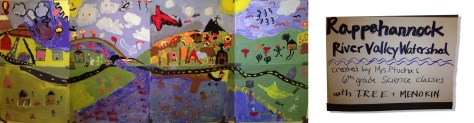
The students of Mrs. Ptucha’s 6th-grade science classes at Richmond County Intermediate School had the opportunity to dive into the Chesapeake Bay Watershed recently – with paint and brushes. The students participated in a Project WETactivity, Make-a-Mural.
They created a mural depicting various aspects of the Northern Neck watershed area, including its landscape, people, cultures, and natural residents – both plant and animal.
The objective of the project was for the students to define the term watershed; identify their local watershed and illustrate it, including water resource issues within it.
Using resource information such as an Enviroscape of Menokin and Watershed Maps, and a diagram of the main components of a watershed (Air, Land, Water, People & Transportation, Architecture, History and Tradition) the students listed examples of each category that are included in their local watershed.
Lastly they studied History & Traditions: what are ways resources have been used in the past that are different from how they are used today? Using the example of Menokin’s cultures and traditions, these ideas were discussed:
The biggest influence on the watershed can be understood through the categories of People and Traditions.
Menokin’s people begin with the Rappahannock Indian Tribes, Francis Lightfoot Lee and subsequent owners, including the current Menokin Foundation.
The Land and its use has changed some over time. Originally used mostly for farming and grazing, most of the land is now under a conservation easement and only a small portion is cultivated.
The Menokin Foundation is now developing the site as an educational and cultural center with a focus on historic and environmental education. As a result, more buildings may be added to the landscape to accommodate these goals. There are also plans to further develop the trail system for visitors use. In doing so, what sort of BMPs (best management practices) should need to be considered for each area of the watershed?
With all of this new-found knowledge and food for thought swirling in their heads, the students were then asked to begin on the mural. Using foam core panels, and acrylic paint, each student worked on designated portions of the watershed – air, land and water.
As you can see from the finished mural above, the results are outstanding. Using color and expression in a way only children can master, the finished product is a true work of art and is hanging in the hallway at the school.
Funding for the A River Runs Through Us Meaningful Watershed Educational Experience was provided by the Chesapeake Bay Trust.
Programming funds were also made possible from a generous environmental grant from the Dominion Foundation.
The program was coordinated by TREE (Three Rivers Environmental Educators) and Alice French, Education and Outreach Coordinator at The Menokin Foundation. This was the first of several programs developed by TREE for Richmond County School and their STEM initiative.
By Alice French – Education and Outreach Coordinator at Menokin
JULY 3, 2013
I spent the day today with Lance and Carl and their Grandmother, Frances Lively.
We learned a little bit about Francis Lightfoot Lee and his house explored the Visitor Center with a scavenger map.
Next we talked about the landscape we were in. We talked about the importance of taking care of the land and water here too. Next we looked at some images by land-art artist, Andy Goldsworthy.
Alice, our day at Menokin was a definite highlight of the week. My grandson did not stop talking about it and gave a full briefing to his grandfather and his parents. Your knowledge, Menokin’s story, and our walk through the house helped transport us to Francis Lightfoot Lee’s era. Thanks for a terrific adventure.
Then we went on a hike. We looked at all the different types of plants we could identify. We walked down the trail to Cat Point Creek. Along the way we talked about the rolling roads and boats coming up the creek to ship merchandise down the Rappahannock River. We identified different trees on the trail, came across a box turtle, and looked for other wild life.
After the trail hike, we took a break at the picnic tables under the trees by the House. Here we pulled out some maps and talked about what a watershed is.
We walked around the house and talked about the architecture and gardens.
Finally before we were done, we made our own piece of Land Art. The boys looked for something in the landscape and built a design inside a tree trunk with walnuts which had fallen to the ground. The first design followed the swirling pattern of the tree trunk. The second one filled up the entire trunk and topped it off with a feather found lying on the ground in front of the house.
It was hot! But we had a lot of fun! And remembered that tomorrow we are celebrating the fact that Francis Lightfoot Lee, would be signing the Declaration of Independence.
If you are planning to shoot summer photos for the Menokin “Seasons” Photo Contest, now is a great time to come.
Here’s a link to the contest rules and application.
Field scabious, or Knautia arvensis may be found in dry fields, grassy places, and flowers between July and September
The Menokin butterfly garden, under the care of the Northern Neck Master Naturalists, is gorgeous this year. Full and lush, it is a nectar smorgasbord for our winged friends.
This tiger swallowtail is enjoying his early bird special.
Black eyed susan, or Rudbeckia hirta, with other common names, such as Brown-eyed Susan or Brown Betty.
Have you ever tried to take a picture of a hummingbird moth? They don’t hold still at all.
This bee knows its balm. Monardas or Bergamots are wild flowers in the mint family, widespread and abundant in much of North America. Flower colors can range from pink to lilac, scarlet or deep red/purple.
Eastern purple coneflower, or Echinacea purpurea. It’s cone-shaped flowering heads are usually, but not always, purple.
Really, I thought these guys only lived in Africa. But in all truth, I have never really done much research on dung beetles, or how they carry out their business.
However, while taking a walk recently, this rather large object moving across my path caught my eye, so I moved closer to investigate. And what I saw was this massive dinosaur-sized beetle, rolling what looked to be a ball of poop. Backwards.
I immediately grabbed my phone to record what I was sure was a once-in-a-lifetime phenomenon in the Northern Neck.
Not knowing what it was exactly, I started with dung beetle because of the whole poop ball aspect of the situation.
Bingo.
So I did a little reading and found an hilarious video about dung beetles on You Tube, which explained a lot of what my dung beetle was up to. So in case you have never seen a dung beetle in action, check out my video. And be sure to watch the You Tube video too, because in spite its lighthearted presentation, there’s a lot of good info in there, too.
Having consulted with Mama Killdeer, Alice and I settled on a quiet theme of Gravel with Scattered Leaves for the nursery. With all preparations done, we settled in to wait for the big arrival with Mama and Papa killdeer.
What a busy week we had!
On Monday, there were only three eggs in the nest. I assumed that my worst fear had come true, and a predator had stolen an egg. Both parents were highly agitated and we left them alone with their grief.
On Tuesday, Sarah and I were in Richmond at a meeting. Alice was holding down the fort with a visiting group of about 40 Master Naturalists here for a lecture about bats. Needless to say, the parking lot was buzzing and there were too many cars too close to the nest. But! With three eggs still in the nest, the MN reported that they had spotted a baby following the adults around. Whew. No snake.
On Wednesday, we had two more hatch. And while we never saw all three at one time, I did sit for awhile to watch the toddlers and saw at least two together.
That last egg still lay in the nest, and we wondered if and when it might join the brood. I had parked my car in such a way as to discourage foot and auto traffic from the area.
The Lone Ranger
By this time, Mama and Papa had gotten pretty used to Alice and me. So when I packed up to leave yesterday evening, Mama was on the nest and didn’t budge when I started loading up my car. Just a few feet from the nest, and with my back to her, I quietly got my camera out of the bag, turned it on and got it all ready to go.
Mama gave me the stink eye, thought about it briefly, and decided she didn’t like it. Off she hopped, with two babies scuttling behind her. In the nest, snuggled together, were #3 AND #4, though at first it was hard to tell them apart. But when #3 ran off to join the family, #4 – obviously freshly hatched – remained in the nest.
Mama scolded from the grass a few yards away, but I did get a few great shots before leaving them alone.
So glad I did, because when I got to work this morning, I was alone. These birds had flown. (Sorry, sometimes I can’t help myself). The nest was empty and there was not a killdeer in sight. What fun we had having them here. Hopefully they’ll nest here again in 2014.
Update – June 26, 2013
Boy, are we ever lucky to have Hullie Moore on the Menokin Board of Trustees. Renowned landscape photographer of the Shenadoah National Park, Hullihen Williams Moore has turned his lens (along with myriad other talents) to Menokin.
Hullie was here for an Education Committee meeting yesterday and I introduced him to Mama and Papa Killdeer. While I stalked the nest, he took these gorgeous shots of their defense and distraction methods.
Fanning out her tail feathers, Mama fakes a broken wing and leads me quickly away from the nest.
Gorgeous feathers.
Papa flew right at us trying to scare us away.
When all else failed, Papa simply stood in the gravel and yelled at us.
The eggs are safe and sound in their gravely nest.
June 19, 2013
Late last week, I noticed a killdeer sitting in the gravel drive that circles in front of the Menokin Visitor’s Center. She wasn’t doing anything odd, but her stillness and lack of activity caught my attention.
The next morning, Alice and I drove in (same morning as the “turtle sighting“) and she was back. Different spot, but just sitting. I remembered back several years ago when one laid eggs right in the parking lot at Nunnally’s in Warsaw, and commented to Alice that I bet that bird was going to lay some eggs in our driveway.
I approached where she was sitting and she hopped up, scolding and dragging her wing in an effort to lead me away from her spot. Not fooled, I scanned the area closely to see if I could find a nest.
Nothing.
I was out of the office the next morning, but called Alice to check on the situation. The killdeer was back again, same spot. Much to the bird’s annoyance, Alice approached to see if there was any activity. Eureka! Two eggs. Mama and Papa Killdeer scolded, limped and yelled, but brave Alice took a picture anyway.
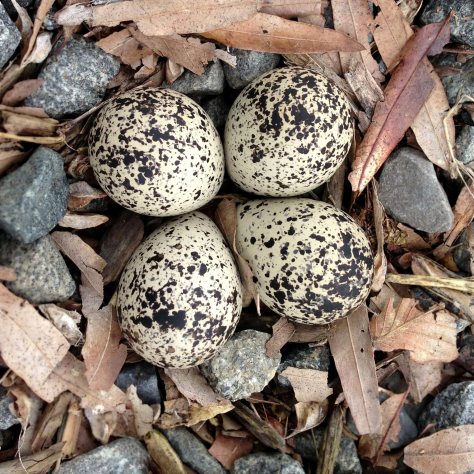
Killdeer nest on open ground, often on gravel. They may use a slight depression in the gravel to hold the eggs, but they don’t line it at all, or line it only with a few stones. Since there is no structure to stand out from its surroundings, a killdeer nest blends marvelously into the background. Furthermore, the speckled eggs themselves look like stones. Can you spot the eggs?
Zooming in, you can see how beautiful they are.
Excited as two expecting moms, Alice and I went into supreme protective mode. Alice dragged two old pallets to block the nest from any vehicles and we started picking out names. (Iris and Rosalie.)
Day three, Alice and I were busy discussing nursery colors and preschools. I went outside to look in on our budding family. Hot tempered Mama (or Papa, as I soon learned) – still displeased with the interruptions – revealed a surprise. Another egg! Three! (New name – Susan.)
Iris, Rosalie and Susan A Killdeer nest is a shallow depression scratched into the bare ground, typically 3-3.5 inches across. After egg-laying begins, Killdeer often add rocks, bits of shell, sticks, and trash to the nest. Curiously, these items tend to be light colored, and this tendency was confirmed in one experiment that gave Killdeer the choice between light and dark sticks.
By now, we have hooked Sarah in on the excitement. What in the world will we ever do with triplets? Too anxious to let a day go by without any news, I stopped yesterday to check on my girls. Mama KD rolled her eyes and obligingly hopped off the nest, too used to me by now to make much of a fuss. Or maybe she was tired from her night’s labors. Because where there once were three, are now four.
We are out of names. What will we do?
Thinking that surely we will have hatchlings by week’s end at the speed we are going, we Googled the gestation period of Killdeer eggs. Much to our disappointment, this part of the process is not speedy.
Baby birds that hatch with their running shoes on are called precocial. Precocial means “ripened beforehand.” (The word comes from the same Latin source as “precocious.”) Killdeer babies are precocial. They hatch with their eyes open, and as soon as their downy feathers dry, they start scurrying about, following their parents and searching the ground for something to eat.
The parent killdeer start sitting on the eggs to incubate them as soon as all the eggs have been laid. The killdeer embryos inside the first-laid three eggs do not start developing while the eggs are sitting out in the cold. But when they feel the warmth of the parent killdeer, all four killdeer embryos start developing at the same time. So even though the first-laid egg spends a longer time in the shell than the last-laid, all the killdeer chicks have the same development period. It takes 24 to 28 days of incubating for the chicks to hatch.
So, while we wait for the babies to come, here are some stunning shots of Mama (or Papa) at work, making sure that we stay far enough away from the eggs.
Killdeer spend their time walking along the ground or running ahead a few steps, stopping to look around, and running on again. When disturbed they break into flight and circle overhead, calling repeatedly. Their flight is rapid, with stiff, intermittent wingbeats.
Killdeer get their name from the shrill, wailing kill-deer call they give so often. Eighteenth-century naturalists also noticed how noisy Killdeer are, giving them names such as the Chattering Plover and the Noisy Plover.
Look for Killdeer on open ground with low vegetation (or no vegetation at all), including lawns, golf courses, driveways, parking lots, and gravel-covered roofs, as well as pastures, fields, sandbars and mudflats. This species is one of the least water-associated of all shorebirds.
Killdeer have the characteristic large, round head, large eye, and short bill of all plovers. They are especially slender and lanky, with a long, pointed tail and long wings.
The Eastern box turtle(Terrapene carolina carolina) is a subspecies within a group of hinge-shelled turtles, normally called box turtles. T. c. carolina is native to the eastern part of the United States.
This handsome fella was crossing the lane at Menokin this morning on our way into work. Alice and I stopped to say hello. We remarked on his beautiful coloring and striking red eyes. A little research into the Eastern box turtle revealed just what those eyes mean.
Eastern box turtles have a high, dome-like carapace and a hinged plastron that allows total shell closure. The carapace can be of variable coloration, but is normally found brownish or black and is accompanied by a yellowish or orange-ish radiating pattern of lines, spots or blotches.Skin coloration, like that of the shell, is variable, but is usually brown or black with some yellow, orange, red, or white spots or streaks. Eastern box turtles feature a sharp, horned beak, stout limbs, and their feet are webbed only at the base.Males normally possess red eyes (irises) whereas females usually display brown eyes. In the wild, box turtles are known to live over 100 years, but in captivity, often live much shorter lives.
Just think, this turtle may have been around when Menokin was still standing.


 Just then, a board member, stopping in for a meeting, came through the front door and asked if we were keeping pigeons as pets. “There’s a tagged pigeon wandering around right outside,” he said. “Does he belong to one of you?”
 Wrong. The pigeon, while not apparently alarmed by our proximity (by this time, I had joined the adventure), kept a healthy and stealthy distance from any semblance of cardboard and/or would-be captors. At one point he even flew up onto the barn roof, alleviating our fears that perhaps he was injured.
 probably hungry and thirsty. We grabbed a box of Cream of Wheat and filled a bowl of water and went out to tend our flock of one. After hunting around we finally found him roosting in the lean-to on some of the large dress stones from the house (it must be a pigeon thing). He seemed mildly annoyed that we had discovered his hideout, but did allow Mavora to eventually get close enough to read the letters and numbers on the tag on his leg.
 I was in awe that there is a whole PIGEON NETWORK out there, flying all around us, that I had never been aware of until then. It inspired me to go outside and sit with the pigeon, who continued to keep a safe distance, and tell him all about Menokin and the Northern Neck.
 emily lyth has been an intern at menokin since april 2014. she lives in richmond county with her family and is currently pursuing her bachelor’s degree from drexel university’s online degree program.


 The Volunteer State Coordinator of VAWS, Robin Clark, along with local sportsman and volunteer, Ford Becker, coordinated the event which brought this group to Menokin to take advantage of the last day of turkey season and the opening day of deer season in early November.


 The students of Mrs. Ptucha’s 6th-grade science classes at Richmond County Intermediate School had the opportunity to dive into the Chesapeake Bay Watershed recently – with paint and brushes. The students participated in a Project WET activity, Make-a-Mural.
 identify their local watershed and illustrate it, including water resource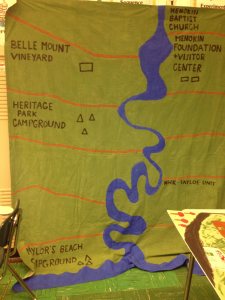
 the students were then asked to begin on the mural. Using foam core panels, and acrylic paint, each student worked on designated portions of the watershed – air, land and water.
 and is hanging in the hallway at the school.


 Really, I thought these guys only lived in Africa. But in all truth, I have never really done much research on dung beetles, or how they carry out their business.