
Killdeer Cam – The Final Episode

Update – July 11, 2013

Having consulted with Mama Killdeer, Alice and I settled on a quiet theme of Gravel with Scattered Leaves for the nursery. With all preparations done, we settled in to wait for the big arrival with Mama and Papa killdeer.

What a busy week we had!

On Monday, there were only three eggs in the nest. I assumed that my worst fear had come true, and a predator had stolen an egg. Both parents were highly agitated and we left them alone with their grief.

On Tuesday, Sarah and I were in Richmond at a meeting. Alice was holding down the fort with a visiting group of about 40 Master Naturalists here for a lecture about bats. Needless to say, the parking lot was buzzing and there were too many cars too close to the nest. But! With three eggs still in the nest, the MN reported that they had spotted a baby following the adults around. Whew. No snake.

On Wednesday, we had two more hatch. And while we never saw all three at one time, I did sit for awhile to watch the toddlers and saw at least two together.

That last egg still lay in the nest, and we wondered if and when it might join the brood. I had parked my car in such a way as to discourage foot and auto traffic from the area.

The Lone Ranger
The Lone Ranger

By this time, Mama and Papa had gotten pretty used to Alice and me. So when I packed up to leave yesterday evening, Mama was on the nest and didn’t budge when I started loading up my car. Just a few feet from the nest, and with my back to her, I quietly got my camera out of the bag, turned it on and got it all ready to go.

Mama gave me the stink eye, thought about it briefly, and decided she didn’t like it. Off she hopped, with two babies scuttling behind her. In the nest, snuggled together, were #3 AND #4, though at first it was hard to tell them apart. But when #3 ran off to join the family, #4 – obviously freshly hatched – remained in the nest.

Mama scolded from the grass a few yards away, but I did get a few great shots before leaving them alone.

Web_killdeer-mom-and-baby

So glad I did, because when I got to work this morning, I was alone. These birds had flown. (Sorry, sometimes I can’t help myself). The nest was empty and there was not a killdeer in sight. What fun we had having them here. Hopefully they’ll nest here again in 2014.

Update – June 26, 2013

Boy, are we ever lucky to have Hullie Moore on the Menokin Board of Trustees. Renowned landscape photographer of the Shenadoah National Park, Hullihen Williams Moore has turned his lens (along with myriad other talents) to Menokin.

Hullie was here for an Education Committee meeting yesterday and I introduced him to Mama and Papa Killdeer. While I stalked the nest, he took these gorgeous shots of their defense and distraction methods.

June 19, 2013

Late last week, I noticed a killdeer sitting in the gravel drive that circles in front of the Menokin Visitor’s Center. She wasn’t doing anything odd, but her stillness and lack of activity caught my attention.

The next morning, Alice and I drove in (same morning as the “turtle sighting“) and she was back. Different spot, but just sitting. I remembered back several years ago when one laid eggs right in the parking lot at Nunnally’s in Warsaw, and commented to Alice that I bet that bird was going to lay some eggs in our driveway.

I approached where she was sitting and she hopped up, scolding and dragging her wing in an effort to lead me away from her spot. Not fooled, I scanned the area closely to see if I could find a nest.

Nothing.

I was out of the office the next morning, but called Alice to check on the situation.  The killdeer was back again, same spot. Much to the bird’s annoyance, Alice approached to see if there was any activity. Eureka! Two eggs. Mama and Papa Killdeer scolded, limped and yelled, but brave Alice took a picture anyway.

Excited as two expecting moms, Alice and I went into supreme protective mode. Alice dragged two old pallets to block the nest from any vehicles and we started picking out names. (Iris and Rosalie.)

Day three, Alice and I were busy discussing nursery colors and preschools. I went outside to look in on our budding family. Hot tempered Mama (or Papa, as I soon learned) – still displeased with the interruptions – revealed a surprise. Another egg! Three! (New name – Susan.)

Iris, Rosalie and Susan
A Killdeer nest is a shallow depression scratched into the bare ground, typically 3-3.5 inches across. After egg-laying begins, Killdeer often add rocks, bits of shell, sticks, and trash to the nest. Curiously, these items tend to be light colored, and this tendency was confirmed in one experiment that gave Killdeer the choice between light and dark sticks.

By now, we have hooked Sarah in on the excitement. What in the world will we ever do with triplets? Too anxious to let a day go by without any news, I stopped yesterday to check on my girls. Mama KD rolled her eyes and obligingly hopped off the nest, too used to me by now to make much of a fuss. Or maybe she was tired from her night’s labors. Because where there once were three, are now four.

We are out of names. What will we do?

Thinking that surely we will have hatchlings by week’s end at the speed we are going, we Googled the gestation period of Killdeer eggs. Much to our disappointment, this part of the process is not speedy.

Baby birds that hatch with their running shoes on are called precocial. Precocial means “ripened beforehand.” (The word comes from the same Latin source as “precocious.”) Killdeer babies are precocial. They hatch with their eyes open, and as soon as their downy feathers dry, they start scurrying about, following their parents and searching the ground for something to eat.
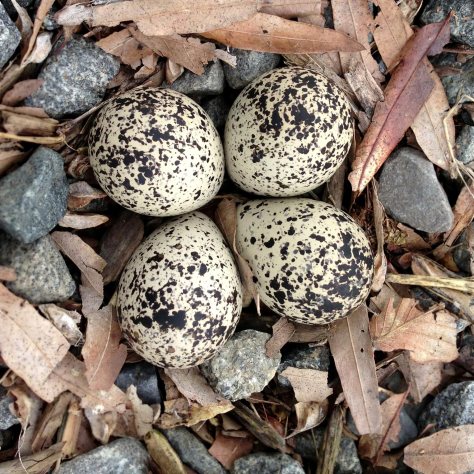
And then there were four.
The parent killdeer start sitting on the eggs to incubate them as soon as all the eggs have been laid. The killdeer embryos inside the first-laid three eggs do not start developing while the eggs are sitting out in the cold. But when they feel the warmth of the parent killdeer, all four killdeer embryos start developing at the same time. So even though the first-laid egg spends a longer time in the shell than the last-laid, all the killdeer chicks have the same development period. It takes 24 to 28 days of incubating for the chicks to hatch.

So, while we wait for the babies to come, here are some stunning shots of Mama (or Papa) at work, making sure that we stay far enough away from the eggs.

It’s a Boy! Eastern Box Turtle at Menokin.

The Eastern box turtle (Terrapene carolina carolina) is a subspecies within a group of hinge-shelled turtles, normally called box turtles. T. c. carolina is native to the eastern part of the United States.

This handsome fella was crossing the lane at Menokin this morning on our way into work. Alice and I stopped to say hello. We remarked on his beautiful coloring and striking red eyes.  A little research into the Eastern box turtle revealed just what those eyes mean.

Eastern box turtles have a high, dome-like carapace and a hinged plastron that allows total shell closure. The carapace can be of variable coloration, but is normally found brownish or black and is accompanied by a yellowish or orangish radiating pattern of lines, spots or blotches.
Eastern box turtles have a high, dome-like carapace and a hinged plastron that allows total shell closure. The carapace can be of variable coloration, but is normally found brownish or black and is accompanied by a yellowish or orange-ish radiating pattern of lines, spots or blotches.
Skin coloration, like that of the shell, is variable, but is usually brown or black with some yellow, orange, red, or white spots or streaks.  Eastern box turtles feature a sharp, horned beak, stout limbs, and their feet are webbed only at the base.
Skin coloration, like that of the shell, is variable, but is usually brown or black with some yellow, orange, red, or white spots or streaks. Eastern box turtles feature a sharp, horned beak, stout limbs, and their feet are webbed only at the base.
Males normally possess red eyes (irises) whereas females usually display brown eyes.  In the wild, box turtles are known to live over 100 years, but in captivity, often live much shorter lives.
Males normally possess red eyes (irises) whereas females usually display brown eyes.
In the wild, box turtles are known to live over 100 years, but in captivity, often live much shorter lives.

Just think, this turtle may have been around when Menokin was still standing.

Francis Lightfoot Lee served in World War II

What? Wrong war, right?

Nope. Francis Lightfoot Lee did take part in World War II – as a Vessel Type EC2: Liberty Ship.

The call went out to American shipbuilders to mobilize for construction of a new fleet of troopships in 1941. “Built by the mile and chopped off by the yard,” and delivered at the rate of one a day, American ingenuity and can-do — facing a global challenge at the end of 1941 — transformed its shipbuilding industry and produced more than 2,700 Liberty ships in five years to move men and materiel to the front.

The Liberty ships — a vast new fleet for the war effort — was built in a national “Virtual Shipyard” that harnessed skills, resources, and facilities all across America. From 1941 to 1945, the United States increased its shipbuilding capacity by more than 1,200% and produced over 2,700 Liberty Ships.

Upon seeing the design for the Liberty ship, which was based on a British ship first built in 1879, President Roosevelt named her “the ugly duckling.” Here are some interesting facts about Liberty Ships:

  • Liberty ships were built in 1943 in as few as 16 days.
  • A Liberty ship could carry an amount of cargo equal to four trains of 75 cars each.
  • Libertys sailed with no name painted on their bows so as to give the enemy no hint as to their mission or cargo.
  • Services of more than 40 skilled trades were required to build a Liberty ship.
  • Every Liberty ship had its own distillation system to make sea water drinkable.
  • The first Liberty ship was named after Patrick Henry. The last 100 were named for merchant seamen who died in wartime service.
  • One hundred and fourteen Liberty ships carried the names of women; eighteen Liberty ships were named for African-American individuals.
  • Our favorite Liberty ship was named for Francis Lightfoot Lee!
FRANCIS L. LEE (E26) Francis L. Lee on February 3rd 1944 in convoy at position 36°56'N 75°00'E east of Cape Hatteras. Owned by U.S. Department of Commerce and operated by Seas Shipping Co. Inc. under WSA Service Agreement form GAA.
FRANCIS L. LEE (E26)
Francis L. Lee on February 3rd 1944 in convoy at position 36°56’N 75°00’E east of Cape Hatteras. Owned by U.S. Department of Commerce and operated by Seas Shipping Co. Inc. under WSA Service Agreement form GAA.
  • Ship Name:      SS Francis L. Lee
  • Namesake:      Francis Lightfoot Lee
  • MC Hull No.:     26
  • Ship type:        Standard
  • Laid down:      13 October 1941
  • Launched:       14 March 1942
  • Fate:               Scrapped 1965

Here’s an invitation from the Menokin Foundation. If you were a crew member on  the Francis L. Lee, or a friend or family member of one of her crew, or a person who helped build her, we would love to hear from you. We welcome your stories and pictures. We also welcome you here at Menokin, the home of your ship’s namesake.

← Back

Thank you for your response. ✨

A Shout Out to Menokin’s Volunteers – Thank You!

thank-you-volunteers

Harvard Design Students Present Their Ideas for Menokin

By Sarah Pope
Executive Director, The Menokin Foundation

Away from the quiet fields of Menokin, I traveled to bustling Cambridge, Massachusetts on May 5 for a much anticipated day at the Harvard Graduate School of Design (GSD).  Twelve architecture graduate students in Professor Jorge Silvetti’s studio, “Ruins, Memory and the Imagination,” would be presenting their individual projects for a Conservation Research Laboratory; a Visitors Center; and Visitors Waterside Harbor at Menokin, as well as the design of all elements necessary to structure and present the Menokin site narratives to the visitor.


The students had been working on their projects for several months, following a weekend-long site visit in February to Menokin and the Northern Neck.  The Menokin Foundation provided the opportunity for these students to explore contemporary architectural design solutions to tell the story of our historic site.

We’re planning for a future curated exhibit and publication that presents the Harvard students’ innovative ideas to the public.  More details will be forthcoming, but in the meantime, here are themes and associated designs that floated to the top for me as I watched the project presentations:

1)      Designing for flexibility: one student designed very cool mobile archaeological stations or pods that can be moved around the site as we continue our investigations.

2)      Finding inspiration in painting and fine arts: another student found inspiration from the lines he saw on the Menokin landscape, and his proposed Visitors Center evoked the work of artist Marco Migani.

3)      The changing terrain of the site: plateau and ravine, water and woods, open and enclosed: I was particularly enamored by one student’s design of a bridge and attached Visitors Center that spans a ravine to the south of the Menokin house site.

4)      Siting and perspective-relationship of new buildings to Menokin: Some students anchored their Visitors Center to the Menokin house—at certain corners of the house or on its central axis—that created a visible dialog between the historic and contemporary structures. Others tucked their new facilities away from the house site into the tree line of our expansive woods, reinforcing the flat, openness of the plateau surrounding the house site.

Above all, the interpersonal, human aspect of this studio—meeting the students, getting to know them and enjoying their unique perspectives on Menokin—was extremely fulfilling to me, as well as to our Trustees, staff, and friends who met the students in February.

Bourbon Saves the Day at the 2013 Menokin Music Festival Pick Nick

This past Saturday was the 10th annual Menokin Music Festival. This music festival has morphed over the years into a simple afternoon of pick nicking, music and fun, all in the shade of the beautiful walnut trees surrounding the Menokin ruin.

So, where does the bourbon come in? Here was the weather forecast for last Saturday…70% chance of scattered showers and thunderstorms, some severe, with a chance of hail and high winds. Oh, and let’s not forget about the Brood II – the 17-year cicadas that were scheduled to appear by the millions at any moment.

Several skeptical folks called ahead to make sure we hadn’t decided to cancel the whole thing. Nope. No way. Rain or shine. Hail or locusts. If the Egyptians could handle it, so could we.  What the Egyptians didn’t have was bourbon. Buried safe in the ground on the site of the festival exactly one month prior to the day. Wild Turkey to be on the safe side. It’s a Southern thing. Guarantees good weather for your event. Every good Virginia bride knows this old trick.

The day dawned gloomy and blustery, with thick scary clouds laughing at us from the sky. Reports were rolling in of heavy rain to the north and south of Menokin. And to be fair, we did get about 18 drops of rain just about the time the first band cranked up. But by the end of the day? Blue skies, fluffy non-sarcastic clouds and calm, cool breezes. Said one band member,”You have made a buried bourbon bottle believer out of me!”

You’re welcome. Enjoy the pics.

2013 Menokin Music Festival Pick Nick

Menokin Canine Corps Awards

Botanical Survey Reveals Uncommon Orchid at Menokin

Excitement was high last week when, at the end of a day of surveying flora in the woods at Menokin, the master naturalists came in to report that they had found what they suspected to be a fairly uncommon orchid growing in the woods.

Master Naturalist Earline Dickinson contacted local botany expert, Ellis Squires, to see if he could make a visit to Menokin to confirm their speculation. The two of them arrived early the following morning, ready to take the trek down the trail to see the orchid.

I decided to tag along and take some pictures. I don’t know if you’ve ever taken a walk through the woods with two botanists. Here’s how it goes. You walk about five feet and then you stop while they identify five varieties of fern, spout out Latin and common names, other sites where these plants have been sighted and friendly explanations of why they are what they are, grow where they grow and are called what they are called so us “non-botanists” don’t feel left out. It was fascinating. I loved every minute of it.

About thirty species later we arrived at the place where the orchid had been found. Sure enough, there it was, nestled in the brown leaves, being as delicate and 009green and purpley-pink as it could in this unusually cool spring weather. Ellis confirmed immediately that we indeed have the uncommon Galearis spectabilis – or Showy Orchis – growing in the woods at Menokin. This plant is fairly uncommon in the area, so the find was a good one.

Also known as the purple-hooded orchis, the flowers are hooded and the namesake of the plant due to the showy, typically bicolored lavender and white 009_croppedflowers. The lavender hood is formed from three fused sepals. Two petals are tucked inside the hood and the labellum (third petal) is longer and white. Plants are slow growing and will form clumps overtime via crown offshoots from the rhizome.

The Showy Orchis is not the only uncommon plant identified that day. Check back for more posts about the other unique and interesting flora that make their home at Menokin.


Plan. Point. Click. Shoot. – Photography Workshop at Menokin

On Saturday afternoon, members of the Rappahannock Art League’s Photography Group gathered at Menokin for an enriching afternoon of philosophy and photography.

Hullie Moore – photographer, thinker, teacher, Menokin Trustee and all-around-great guy – shared his time and expertise with the group. I was unfortunately unable to attend, but I would like to share the email I received from Micki Clay, the Photography Group’s Coordinator and a fabulous photographer in her own rite.

Here is a picture I took of Hullie last year when he and his camera were just beginning their love affair with Menokin.

We had a marvelous afternoon with Hullie at Menokin yesterday. He packed more truly useful information into his 25-minute talk than any photography presentation I’ve ever seen, and he did it in a witty, warm, and engaging manner. He put us at ease instantly.

He worked with each one of us…encouraging us to use our tripods and sharing his with those who hadn’t brought theirs, pointing out interesting subjects and perspectives, viewing our shots and suggesting composition and setting tweaks to get it just so, gently prodding us to stick with it, so the day would yield one or two really good images instead of a bunch of throwaway snapshots.

I am just starting to put a lot more thought and planning into my photography. It’s a little daunting after years of snapping away, hoping that so much quantity would yield a few quality keepers. But, as Hullie said yesterday, you actually make your own luck, by scouting your subject and figuring out when and how to shoot it before you even pick up your camera. Doing just that with Hullie at Menokin yesterday was a transformative experience.

Thank you again for giving us this exceptional experience,

Micki

If you’re photography group is interested in organizing a workshop at Menokin, contact me at lrennolds@menokin.org.

Eruditionem ilex.

Here are three things I learned this past Saturday:

1. The Latin word for holly is ilex.
2. There are whole societies of people who are organized around their love and knowledge of genus ilex.
3. These Holly Society people are fun!

web_004I learned all of these things because the Colonial Virginia Chapter of the Holly Society of America held their meeting at Menokin on Saturday.

The Holly Society of America, Inc. is an active, non-profit organization with members throughout the United States and numerous foreign countries. The purpose of the Society is to stimulate interest, promote research, and collect and disseminate information about the genus Ilex. The society provides the medium for all people interested in hollies, including both novices and skilled growers, to communicate and exchange information through scientific studies, publications, lectures, meetings, visiting holly collections, and other educational endeavors.

I have to admit that I had no idea what to expect, but definitely not who showed up. The front line of organizers swarmed in and within minutes transformed the Menokin Visitor’s Center into Holly Central. There was a table for holly clippings, a table for FOOD (lots and lots of food), a table for books about holly, and a table for fern (yes, fern – go figure) samples for the day’s lecture.


There was also a patio full of beautiful potted plants for the auction that concluded the activities. The proceeds from the auction are earmarked to send a well-deserving 5th grader from Gloucester to Nature Camp. As a former Nature Camper myself, I threw in a winning bid for a pair (male and female) of
Ilex verticillata “Chrysocarpa” (yellow-fruited winterberry) bushes.


The members of the Colonial Virginia Chapter came from all over – many from Tidewater, some from the Northern Neck, a few from Maryland, and two visitors from Ohio. All were new to Menokin and enjoyed hearing about our programs and plans.

By the end of the meeting I felt as if I was bidding farewell to old friends.


Here’s What Geocachers Are Saying About Menokin

Geocaching_logoI have read about this place. Never knew I would make it here. Thanks so much! Awesome place and enjoyed the walk and history!


Geocaching_logoMenokin was definitely on our to-do list. It was better than we anticipated. We had the muggle-free run of the place.


Geocaching_logoI finally made it down to Menokin. I have been wanting to visit this site for some time now. Nice location.


Geocaching_logoI’ve seen these caches on my maps for many months and glad to finally get here. This area is nothing like I imagined.


Geocaching_logoIt was difficult to find a cache for this county that didn’t take us completely out of our way. But reading this cache description, we knew this would be the perfect place to stop. We checked out the visitors center as well, and found the volunteer to be extremely helpful and friendly. We are already planning a return trip.


Geocaching_logoI am having a great time walking the grounds here.