
Category Archives: The People

Menokin’s Original Presentation Drawing

The Foundation recently purchased a high resolution copy of the original presentation drawing for Menokin from the Virginia Historical Society.

This beautiful image is so well scanned that you can see the creases in the paper, and clearly make out the handsome handwriting outlining the intended use for each room. Though the drawing is not signed, handwriting analysis suggests that John Tayloe II was its creator.

Pen and Ink Plan for Menokin c. 1769. Courtesy of the Virginia Historical Society.

The story of how this drawing came to be the property of the VHS is an interesting one. An collection of oral history events surrounding Menokin, that was created in the Foundation’s early years, tells the story like this:

On that same day in 1964 that the last of three maiden Tayloe aunts moved out of Mt. Airy, Polly Montague Tayloe moved in. Because her husband, Colonel H. Gwynne Tayloe, Jr., was stationed at Fort Monroe, she was alone in the great stone house, the home of Rebecca Tayloe Lee before her marriage, nearly 200 years earlier.

Without immediate neighbors, and not yet knowing the people of Warsaw, Mrs. Tayloe spent her days in the relative warmth of the dining room sorting Tayloe papers into three wicker clothesbaskets. The first basket held piles of papers from cabinets beneath window seats. The second and third were for things to keep and things to discard.

“They had every letter in the world,” said Mrs. Tayloe. “I thought most of it was important enough to keep. I found the bill for the church communion service. It was 100 years old.”

What she found as well was the original 1769 presentation  drawing of Menokin, prepared not as a blueprint, but as an appealing pen-and-ink illustration of the proposed finished residence. Although Mrs. Tayloe had never seen Menokin, she was aware of its existence and recognized the drawing immediately by its similarity to the wings at Mount Airy.

Subsequently, after finding a trunk filled with more family papers, she phone John Jennings, then Executive Director of the Virginia Historical Society, to see if he’d like to visit some day to peruse the collection. He arrived one hour later.

“I showed him the Menokin drawing,” said Mrs. Tayloe, “and he nearly fell over.” He took that and other family papers back to the Historical Society. “There were 52,000 pieces in all,” said Mrs. Tayloe, “and some were dated in the 1600s.”

“The odds of locating that drawing were a million to one,” said Taliaferro (Harry “Tuck” Taliaferro III, founding Menokin Trustee and current Honorary Trustee). “Mount Airy was gutted by fire in the 19th century. When Mrs. Tayloe found the drawing, people flipped.”

It is one of the only original presentation drawing from colonial Virginia to survive.
Exploring The Watershed Through Art

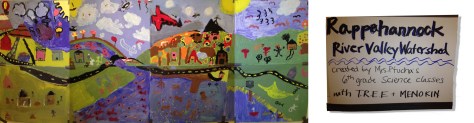
web_Complete-MuralThe students of Mrs. Ptucha’s 6th-grade science classes at Richmond County Intermediate School had the opportunity to dive into the Chesapeake Bay Watershed recently – with paint and brushes. The students participated in a Project WET activity, Make-a-Mural.

They created a mural depicting various aspects of the Northern Neck watershed area, including its landscape, people, cultures, and natural residents – both plant and animal.

The objective of the project was for the students to define the term watershed;web_mural-painting identify their local watershed and illustrate it, including water resource issues within it.
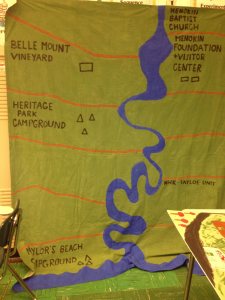
Using resource information such as an Enviroscape of Menokin and Watershed Maps, and a diagram of the main components of a watershed (Air, Land, Water, People & Transportation, Architecture, History and Tradition) the students listed examples of each category that are included in their local watershed.

web_watershed-map

Lastly they studied History & Traditions: what are ways resources have been used in the past that are different from how they are used today? Using the example of Menokin’s cultures and traditions, these ideas were discussed:

  • The biggest influence on the watershed can be understood through the categories of People and Traditions.
  • Menokin’s people begin with the Rappahannock Indian Tribes, Francis Lightfoot Lee and subsequent owners, including the current Menokin Foundation.
  • The Land and its use has changed some over time. Originally used mostly for farming and grazing, most of the land is now under a conservation easement and only a small portion is cultivated.
  • The Menokin Foundation is now developing the site as an educational and cultural center with a focus on historic and environmental education. As a result, more buildings may be added to the landscape to accommodate these goals. There are also plans to further develop the trail system for visitors use. In doing so, what sort of BMPs (best management practices) should need to be considered for each area of the watershed?

With all of this new-found knowledge and food for thought swirling in their heads, web_paint-and-brushesthe students were then asked to begin on the mural. Using foam core panels, and acrylic paint, each student worked on designated portions of the watershed – air, land and water.

As you can see from the finished mural above, the results are outstanding. Using color and expression in a way only children can master, the finished product is a true work of art web_kids-paintingand is hanging in the hallway at the school.

Funding for the A River Runs Through Us Meaningful Watershed Educational Experience was provided by the Chesapeake Bay Trust.

Programming funds were also made possible from a generous environmental grant from the Dominion Foundation.

The program was coordinated by TREE (Three Rivers Environmental Educators) and Alice French, Education and Outreach Coordinator at The Menokin Foundation. This was the first of several programs developed by TREE for Richmond County School and their STEM initiative.

Menokin Carpentry Workshop Nailed It!

What better way to spend a rainy, Northern Neck weekend than in a wood shop, surrounded by antique (and yes, some electric) tools, aromatic shavings and fun people?

A group of 15+ gathered at Menokin on an early October weekend to learn some tricks of the trade in restoring and recreating wooden features of old buildings. Instructors from Oak Grove Restoration shared helpful information such as choosing the right wood for the job, the history of wood and why the old stuff is better than the new stuff, and which tools do what.

Plenty of hands-on activities had students carving, scraping, smoothing, sharpening and drilling. Enjoy the pictures!

Stayed tuned for information about our next workshop, which will probably be in the Spring.

People in Glass Houses Should Throw Parties

Well, officially we’re not IN the glass house yet. But it is certainly in us, as well as within a dedicated group of supporters and friends who came to the official Menokin Project Model unveiling party on Friday, October 4th.

Menokin Trustees and staff,  Union First Market Bank Officers and Board Members, and guests, gathered on the lawn at the house site to celebrate the arrival of the model in style.

Designed and fabricated by Machado and Silvetti Associates, LLC, the model will play a significant role in teaching about, and raising money for, the strategic rehabilitation of this National Historic Landmark.

Menokin Board Member, James Zehmer, In The News

Source: Richmond Times Dispatch
Posted: Saturday, August 3, 2013 9:56 am | Updated: 12:27 am, Mon Aug 5, 2013.

Slate holds clues to U.Va. architecture

BY J. REYNOLDS HUTCHINS The Daily Progress

CHARLOTTESVILLE — It’s hard to imagine that an institution as storied as the University of Virginia would have any more stories to tell. But, according to preservationists at Mr. Jefferson’s university, a recent discovery has reaffirmed that the 194-year-old institution can still teach — and surprise — those who walk its Grounds.

Senior historic preservation planner Brian Hogg said his colleague, James D.W. Zehmer, was walking along the scaffolding above the university’s West Range, just off the Lawn, when something caught his eye.

“They’re replacing the slate on the West Range: the west side of Jefferson’s original group of buildings at the university,” Hogg said Friday.

“A decent amount of the slate dates to the 1830s, but a lot of it’s been replaced over the years because it’s been leaking,” Zehmer explained. “We knew we wanted to save some of the 1830s slate, so I basically walked the whole job.”

That’s when Zehmer saw holes punctured into the original slate.

After careful analysis and comparative study, Hogg and Zehmer concluded that the holes were not an error in masonry or product of erosion, but very complicated construction details.

The details, Zehmer said, reveal that the university’s buildings didn’t always appear as they do now.

slate“It’s basically a little square hole in the sheathing that shows where an iron bracket was attached to the roof to support a balustrade or parapet or a railing,” Hogg said.

According to Hogg and Zehmer, the notches in the Range’s original slate roof indicate that the row of student housing and facilities off Jefferson’s original Lawn was once crowned with an ornamental railing.

“We don’t know exactly how tall they were,” Zehmer said. “But depending on that, they could have helped make a roof look flatter than it might have been. That was kind of one of Jefferson’s favorite techniques.”

The discovery, Hogg and Zehmer said, is an important reminder for preservationists and historians that nothing is ever known for certain.

Artistic renderings dating to 1856, such as a well-known Bohn print on display in the Dome Room in the university’s Rotunda, show the Ranges and other buildings off the Lawn with what appear to be parapets, or low railings. But “we’re always a little hesitant about believing artwork,” Zehmer said.

For decades, historians and preservationists had believed that the parapets, like the mammoth Rotunda and the leveled Lawn, may have been more fiction than fact, but the West Range finding has put their original assumptions into perspective.

“What’s really important to understand is that we’re not owners of this place,” Zehmer said. “We’re stewards in one place and time.”

History Detectives

cbgs camp web (3)The Menokin Visitor’s Center and Site played host for three days recently, when approximately 90 kids, ages 9 to 13, participating in the Chesapeake Bay Governor’s School Summer Program, came here to learn about the house, the land and the people who have lived here.

Organized by Menokin Education Coordinator, Alice French, each student was given a field book for their notes and observations. Among other things, they learned:

  • How to draw an elevation of the house CBGS-Summer-Camp-(5)
  • What materials make up the house, how they are layered and why and what the size, shape, landscaping and design of the house tells us about the people who lived in it.

Students studied examples of documents recording each families’ history here.
By looking at Menokin records – census, inventories, letters – they were able to make comparisons of changing relationships to the house.

Becky Marks and Sharon Parr from the Richmond County Museum brought in an extensive collection of Indian artifacts from the tribes that inhabited Menokin and nearby areas in pre-Colonial times. The students were able to handle projectile points, pottery shards and animal skins, and learned how they were made and what purposes they served in the day to day lives of these indigenous people.

History went underground in the afternoon when the students were able to work with a team of archaeologists from DATA Investigations on actual digs happening on the property. Two test units located in close proximity of the house were established to conduct professionally supervised excavations that incorporated student involvement while pursuing established research goals of the Menokin Foundation.

Existing artifacts were also available for students to learn methods of cleaning washing those that are actually excavated from the ground.

The week ended with a gaggle of happy campers!

"Happy campers!"
“Happy campers!”


Francis Lightfoot Lee served in World War II

What? Wrong war, right?

Nope. Francis Lightfoot Lee did take part in World War II – as a Vessel Type EC2: Liberty Ship.

The call went out to American shipbuilders to mobilize for construction of a new fleet of troopships in 1941. “Built by the mile and chopped off by the yard,” and delivered at the rate of one a day, American ingenuity and can-do — facing a global challenge at the end of 1941 — transformed its shipbuilding industry and produced more than 2,700 Liberty ships in five years to move men and materiel to the front.

The Liberty ships — a vast new fleet for the war effort — was built in a national “Virtual Shipyard” that harnessed skills, resources, and facilities all across America. From 1941 to 1945, the United States increased its shipbuilding capacity by more than 1,200% and produced over 2,700 Liberty Ships.

Upon seeing the design for the Liberty ship, which was based on a British ship first built in 1879, President Roosevelt named her “the ugly duckling.” Here are some interesting facts about Liberty Ships:

  • Liberty ships were built in 1943 in as few as 16 days.
  • A Liberty ship could carry an amount of cargo equal to four trains of 75 cars each.
  • Libertys sailed with no name painted on their bows so as to give the enemy no hint as to their mission or cargo.
  • Services of more than 40 skilled trades were required to build a Liberty ship.
  • Every Liberty ship had its own distillation system to make sea water drinkable.
  • The first Liberty ship was named after Patrick Henry. The last 100 were named for merchant seamen who died in wartime service.
  • One hundred and fourteen Liberty ships carried the names of women; eighteen Liberty ships were named for African-American individuals.
  • Our favorite Liberty ship was named for Francis Lightfoot Lee!
FRANCIS L. LEE (E26) Francis L. Lee on February 3rd 1944 in convoy at position 36°56'N 75°00'E east of Cape Hatteras. Owned by U.S. Department of Commerce and operated by Seas Shipping Co. Inc. under WSA Service Agreement form GAA.
FRANCIS L. LEE (E26)
Francis L. Lee on February 3rd 1944 in convoy at position 36°56’N 75°00’E east of Cape Hatteras. Owned by U.S. Department of Commerce and operated by Seas Shipping Co. Inc. under WSA Service Agreement form GAA.
  • Ship Name:      SS Francis L. Lee
  • Namesake:      Francis Lightfoot Lee
  • MC Hull No.:     26
  • Ship type:        Standard
  • Laid down:      13 October 1941
  • Launched:       14 March 1942
  • Fate:               Scrapped 1965

Here’s an invitation from the Menokin Foundation. If you were a crew member on  the Francis L. Lee, or a friend or family member of one of her crew, or a person who helped build her, we would love to hear from you. We welcome your stories and pictures. We also welcome you here at Menokin, the home of your ship’s namesake.

← Back

Thank you for your response. ✨

A Shout Out to Menokin’s Volunteers – Thank You!

thank-you-volunteers

Minimester at Menokin – St. Margaret’s Students Pay Us A Visit

Some students from St. Margaret’s School in Tappahannock spent an afternoon at Menokin late in February as part of their “minimester” program.

Minimester as described on the SMS website:

Creative inquiry, experiential learning and the study of interdisciplinary topics are all intrinsic to each Minimester course. Every February, faculty teams teach one week courses outside the core subject areas, giving students the opportunity to learn during extended periods of time and with more hands-on experience.

This group’s focus, led by instructor Dale Harder, was to embark on an in-depth exploration of historic places in Virginia. They visited Monticello, Mt. Vernon and Stratford Hall before coming to Menokin.

Though short on time, the students did a little research on one of Menokin’s artifacts. The dictionary pictured below was found on the floor of Menokin in 1965 by then University of Virginia student Calder Loth. The SMS students were unable to find anything definitive, but did learn that there was a Richard H. Lyell (b. 1818 – d. 1901) that is now buried at Calvary Church Cemetery in Richmond County, VA. Perhaps this is the same man from whom the dictionary was purchased?

Here is a picture of the condition of one of the interior rooms at Menokin taken during that 1965 visit. The Southside Bank calendar on the wall is dated 1941. How long had it been since someone had lived in this room? And who was the last person to use the dictionary?

Picture1

Menokin’s Mysterious Jar

The Menokin Foundation is very fortunate to have a large collection of masonry, stone, construction timbers and interior paneling. But because the house passed hands many times after the deaths of Frank and Becky Lee, and eventually out of the Lee and Tayloe families all together, there are no interior furnishings or decorative items left from the time of their ownership.

Indeed, the only furnishings from Menokin that we have were donated in 2009 by Mrs. Douglas Forrest Barnes. These gifts included a 19th-century walnut table and chairs, and a stoneware jar, which belonged to the Belfield family who owned and occupied Menokin from 1879 to 1935. (Read more about the history of this gift below.)

collection-layers

Our current student intern, Allie Lyth, was tasked with researching the stoneware jar, about which little has ever been known. Her efforts uncovered a genre of primitive ceramics called “American Salt Glazed Ovoid Stoneware,” where our jar seems to fit nicely.

Salt Glazed blue decorated 19th-century Ovoid Jars have some defining characteristics. Samples found online explain the similarities and difference between jars from different states, which often varied in style, design, color and handles.

Samples of Ovoid Stoneware jars from Z&K Antiques.

The design on the image of the jar below, from the Cowan’s Auction website, is very similar to the design on Menokin’s jar. Note the difference between the two in the shape of the lip and the overall shape of the jar.

Second quarter 19th century, semi-ovoid jar having applied lunate handles and brushed tulip and leaf designs surrounding the exterior; attributed to Virginia. Image courtesy of Cowan's Antiques.
Second quarter 19th century, semi-ovoid jar having applied lunate handles and brushed tulip and leaf designs surrounding the exterior; attributed to Virginia. Image courtesy of Cowan’s Antiques.

Menokin’s unsigned Ovoid jar has a “catty-wampus” shape with its lopsided opening and irregular body. Does this hurt or increase the value? Perhaps a trip to Antiques Roadshow is in order?