Wednesday, February 27, 2013 marks the 247th anniversary of the signing of the Leedstown Resolves in Westmoreland County, VA in 1766. The document was the first organized protest of “taxation without representation” and was in opposition to the British imposition of the Stamp Act which required colonists to pay a duty on exports. Signers pledged “to bind ourselves to each other….with our lives and fortunes.”
The Northern Neck of Virginia Historical Society (NNVHS) will present its annual program commemorating this historic event at Menokin, the home of Francis Lightfoot Lee, who, along with his brother Richard Henry Lee, signed both the Leedstown Resolves and the Declaration of Independence.
Signers highlighted in past years have been resolution author Richard Henry Lee and brother Francis Lightfoot Lee, as well as Alvin Moxley, Meriwether Lee, William Sydnor, Moore Fauntleroy, Francis Waring, and William Roane.
The 2013 commemoration will feature the lives of signers Richard “Squire” Lee of Lee Hall, Robert Wormeley Carter of Sabine Hall, John Belfield of Belle Mount, and Joseph Peirce of Templesman.
The program is being prepared by the NNVHS and hosted by the Menokin Foundation at the Martin Kirwan King Visitor’s Center at Menokin, located at 4037 Menokin Road in Warsaw, VA. Driving directions are available on the Menokin website at or by calling 804-333-1776. The program begins at 10:00 a.m. and all are invited to attend.
The Menokin Foundation is very fortunate to have an Advisory Council of professionals in the fields of architecture, engineering, historic conservation, museum programs and cultural landscape which has been established to assist in the decision making process of the Glass Concept.
Staff members sat down with some of these advisors over dinner last fall and interviewed them about why they love Menokin, and why they have dedicated so much time to this project.
The result is this video which attempts to encapsulate the spark of imagination, inspiration and innovation that is Menokin.
Tired of presidential candidates? Weary of the “approved messages” bombarding you from television ads? Longing for a fresh face to breathe hope into our political melee?
You are in luck. Frank has cast his hat into the political arena and is looking for your vote.
In this Presidential Election year, we thought it might be fun, educational and enlightening to examine the life of this 18th-century “politician” to see how he stands up to today’s candidates in character, record and opinion (both about
him and by him).
What Kind of Man Was Francis Lightfoot Lee?
Francis Lightfoot Lee is what one might call a “forgotten revolutionary.” Described by his niece as the “sweetest of all the Lee race” and as possessing a temper “as soft as the dove’s,” Lee, his memory now nearly hidden beneath the rubble of his Virginia mansion, had a life that was “most useful and worthy,” the life of a patriot of the American Revolution.
With thirty years of an active political life, a life in which he opposed British measures, sought independence, and served the nation through a number of committees as a member of the Virginia House of Burgesses, the Second Continental Congress, and the Virginia State Senate. Lee was certainly not an “inconspicuous” man, nor was he merely “soft as a dove.” Rather, Lee was a true patriot, not only according to standards held by his contemporaries, but also to his own.
Is Frank Lee the kind of man that could run for President in 2012? If so, could he win?
Resume
• In 1758, he took his seat as representative of Loudoun County to the Virginia House of Burgesses, having moved there to maintain his lands inherited from his father.
• He became an opponent to taxation without representation and other British offenses, which he protested not only through personal letters, but also in signing his support to important documents, including the Westmoreland Resolves of 1766.
• As a member of a committee appointed to protest British policies toward the colonies in 1768, Lee maintained an active role in opposition to the British.
• Lee continued to serve as a Burgess from Richmond County until elected as a Virginia delegate to the Second Continental Congress in August 1775. He fully supported American Independence throughout most of his political career, signing the Declaration of Independence on July 4, 1776.
• Lee remained a member of Congress until 1779, serving on a variety of committees including the Board of War, Committee of Secret Correspondence, and other ad-hoc committees.
• In 1779, Francis Lightfoot Lee retired from the Second Continental Congress due to the three-year limit that had since been imposed by the Revolutionary Government.
• In 1780, Lee again entered Virginia politics, having been elected to serve as a member of the Virginia Senate, until 1782 when he retired from politics. He did, however, remain interested in the political scene, and is purported to have supported the ratification of the Constitution.
This man’s life-work was so inconspicuous, that his name would now be wholly forgotten, but for one thing- he signed the Declaration of Independence. Yet his life was a most useful and worthy one. It was a good and profitable voyage, though it left no phosphorescent splendors in its wake.
–Mark Twain on Francis Lightfoot Lee, 1877
Character
Not a lot is written about Francis Lightfoot Lee, as he was certainly overshadowed in the political arena by his outspoken older brother, Richard Henry Lee. Yet those that did pause to put their thoughts about him on paper seem to agree that he was a quiet, thoughtful yet passionate man.
Lee has not been granted his proper place in history, for his involvement with the
founding of the country lays not only in his signature on a document, but with thirty years of an active political life, a life in which he opposed British measures, sought
independence, and served the nation through a number of committees as a member of the Virginia House of Burgesses, the Second Continental Congress, and the Virginia State Senate. Lee was certainly not an “inconspicuous” man, nor was he merely “soft as a dove.” Rather, Lee was a true patriot, not only according to standards held by his contemporaries, but also to his own.
He dealt in no shams; he had no ostentations of dress or equipage. He was educated. He was more than that – he was finely cultivated. Mr. Lee defiled himself with no juggling, or wire-pulling, or begging, to acquire a place in the provincial legislature, but went thither when he was called.
–Mark Twain, from the Pennsylvania Magazine of History and Biography, I, no.3, 1877
As for whether or not Francis Lightfoot Lee had “the right stuff” to be a political leader of the 21st century, perhaps his own words shed the greatest light on that question.
This is not the time for men of abilities with good intentions to be only spectators, if we can’t do all the good we cou’d wish, let us at least endeavour to prevent all the mischief in our power.
Commentator Thea Marshall recently learned about a famous architect who’ll be putting back together again a famous pile of rubble.
Of course, the famous architect is Jorge Silvetti – of Machado and Silvetti Associates – and the famous pile of rubble is Menokin, a National Historic Landmark and the Commonwealth’s largest and most historic jigsaw puzzle.
This essay, as comfortable to listen to as a favorite tune, is chock full of information about Menokin – the place, the people who lived here, and what the future holds for this historic treasure.
Thea Marshall is the author of “Neck Tales: Stories from Virginia’s Northern Neck,” published in June, 2009. Along with her professional writing assignments, she is a broadcaster, actor, and producer, with life long experience in all forms of communication – from print to theater to radio and television. She writes and broadcasts original commentaries on and about the people, places, history, culture and current issues relating to the Northern Neck for WCVE Public Radio (heard on both WCVE in Richmond and WCNV for the Northern Neck).
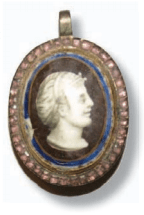
In 2009, archaeologists found a beautiful locket in the Menokin house ruin. This cameo locket portrays the image of a woman. Who did this locket belong to? Who is this woman? A 1794 letter from Frank’s brother, William, may just be the key to unlocking this mystery!
In 1785, two years after the death of his wife, Hannah, William Lee sent his two daughters, Portia and Cornelia, to live at Menokin with Uncle Frank and Aunt Becky. Hannah Lee thought it important that her daughters grow up in Virginia. William wrote to family friends in London, Mr. and Mrs. Samuel Thorp, to further explain the desire for his daughters to grow up in Virginia. He writes, “[H]owever superior English education may be to what can be obtained here[,] yet the manners & customs of the ladies in England are so extremely different from the ladies here [in Virginia] that I never knew an instance of a young lady educated in England who could live happily here.”
He also wrote to the Thorpes requesting a momento by which Portia and Cornelia could remember them. He writes, “Our dear girls at Menokin are so importunate to have a miniature picture for each of them of your self & good Mrs. Thorp…have them set in gold to wear as bracelets…or a locket…the form should be rather a long than a round oval not too sharp at the ends…”
Could this be Mrs. Thorp on the locket? Did it once adorn the neck or wrist of young Portia or Cornelia Lee?
We hope to answer these questions with further research. In the meantime, tell us what you think and check back at Menokin Monitor for updates on this locket and other objects at Menokin.
We’d like to thank the Virginia Chapter of the Colonial Dames whose generous grant helped stabilize the locket. The locket is on display in Menokin’s Visitor’s Center.

 The Northern Neck of Virginia Historical Society (NNVHS) will present its annual program commemorating this historic event at Menokin, the home of Francis Lightfoot Lee, who, along with his brother Richard Henry Lee, signed both the Leedstown Resolves and the Declaration of Independence.
 The program is being prepared by the NNVHS and hosted by the Menokin Foundation at the Martin Kirwan King Visitor’s Center at Menokin, located at 4037 Menokin Road in Warsaw, VA. Driving directions are available on the Menokin website at or by calling 804-333-1776. The program begins at 10:00 a.m. and all are invited to attend.