Martin Kirwan King
Conservation and Visitor’s Center
4037 Menokin Road l Warsaw, VA 22572
Instructors from Oak Grove Restoration
Hank Handler – President
Patrick Handler – Vice President
During more than thirty-five years in business, Oak Grove Restoration Company has evolved from a high-quality woodworking shop into a full-service general contracting and consulting company specializing in historic preservation and the careful conservation of irreplaceable historic architectural fabric. Their diverse client base includes state and local governments, the National Trust for Historic Preservation, the National Park Service, private homeowners, historic sites, and house museums.
Oak Grove has worked at Menokin for many years, starting with the return of the interior paneling to the property in the 1990s, and continuing with the stabilization and catwalk system that exists today. They are part of The Menokin Project Team.
Course Description
Day 1: History of Wood
Old growth and Second growth
Wood quality
Grading lumber
Specific woods for specific jobs
Skills and knowledge gained: a comprehensive understanding of unique qualities of wood species and their use in traditional building
Day 2: Traditional Tools and Methods
Traditional woodworking tools
How to make repairs to beams, splices, scarf joints, Dutchman etc.
Window design, restoration, and maintenance
Door design, restoration, and maintenance
Skills and knowledge gained: a preliminary
Knowledge of traditional wood working tools and their uses; an understanding of the traditional
Design of wood windows
Get Your Name On The Registration List now by sending us an email at menokin@menokin.org. Please be sure to include your full name and a phone number.
Once the registration information is finalized, we will contact you to see if you are still interested and would like to confirm with a paid registration.
Some students from St. Margaret’s School in Tappahannock spent an afternoon at Menokin late in February as part of their “minimester” program.
Minimester as described on the SMS website:
Creative inquiry, experiential learning and the study of interdisciplinary topics are all intrinsic to each Minimester course. Every February, faculty teams teach one week courses outside the core subject areas, giving students the opportunity to learn during extended periods of time and with more hands-on experience.
This group’s focus, led by instructor Dale Harder, was to embark on an in-depth exploration of historic places in Virginia. They visited Monticello, Mt. Vernon and Stratford Hall before coming to Menokin.
First stop, reading the signs.
Second stop, lovely ladies and the Menokin wall.
Third stop, hamming it up in the wine cellar.
Though short on time, the students did a little research on one of Menokin’s artifacts. The dictionary pictured below was found on the floor of Menokin in 1965 by then University of Virginia student Calder Loth. The SMS students were unable to find anything definitive, but did learn that there was a Richard H. Lyell (b. 1818 – d. 1901) that is now buried at Calvary Church Cemetery in Richmond County, VA. Perhaps this is the same man from whom the dictionary was purchased?
Here is a picture of the condition of one of the interior rooms at Menokin taken during that 1965 visit. The Southside Bank calendar on the wall is dated 1941. How long had it been since someone had lived in this room? And who was the last person to use the dictionary?
Just when you think you can’t stand one more, gray, damp, dreary day of February, the hardy daffodil pops up to save the day.
The woods at Menokin are resplendent with the paint daubs of yellow that are splattered among the leaf litter on the forest floor. They grow in clumps that are spread like a stream along a bed known only to them.
There is debate about when these harbingers of spring were first brought to Colonial America. There are many accounts of a wide variety of narcissus bulbs being cultured and coveted in the early days of our country.
The variety we have here is known as Narcissuspseudonarcissus L. – daffodil. and the USDA credits them as being a native plant to Virginia as well as 26 other states.
USDA-NRCS PLANTS Database / Britton, N.L., and A. Brown. 1913. An illustrated flora of the northern United States, Canada and the British Possessions. 3 vols. Charles Scribner’s Sons, New York. Vol. 1: 532.
All I know is that when you need a late winter boost of spirit, gazing into a bouquet of daffodils is just what the doctor ordered.
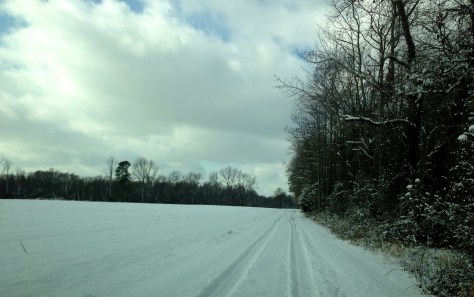
There’s nothing better than waking up really early to find school closings rolling across the tv screen and a ghostly white landscape glowing in the predawn darkness.
After rolling over and falling into a snow day sleep-in coma, I woke up with a desire to see Menokin in the snow. Never one to shy away from an adventure, my husband was easily convinced to chauffeur me across the river to collect my laptop and shoot some pictures.
I never tire of the beauty of the Northern Neck landscape. I hope you agree.
Enjoy!
Mill Pond RoadMount Airy mill pond.Mount Airy mill pond.Snowy lane into Menokin.
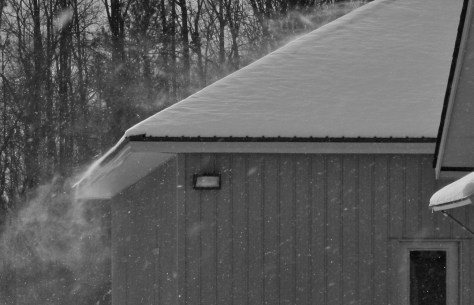
Blow winds, blow.My daughter is happy to be out of school for the day.
March 9 – 10, 2013
Architectural Workshop: Lime Mortar Conservation
Registration and class information are now available. Follow this link to a printable PDF. Registration and payment deadline is March 4, 2013. Student and student group rates are available.
Menokin staff, trustees, friends and photo contest participants gathered on a dark Friday evening to enjoy the results of the first ever Menokin Photography Contest.
Participants gathered from as far away as Gloucester and Northern Virginia to view the winning entries judged by Hullihen (Hullie) Williams Moore. Photos from three categories – architecture, landscape and wildlife – were judged on composition, quality and creativity. Each category was beautifully represented with winners as follows:
Best in Show
Photographer: Alice Reed
Category: Architecture
Title: “Stairway to the Green Top”
First Place
Photographer: Bonnie Ferguson Butler
Category: Architecture
Title: “Reassembled”
First Place
Photographer: Dixie Osteen
Category: Landscape
Title: “Sun Through The Trees”
First Place
Photographer: Angela Dawson
Category: Wildlife
Title: “Spread Your Wings”
Second Place
Photographer: Jim Beam
Category: Architecture
Title: “The Rise and Fall”
Second Place
Photographer: Cindy Taylor
Category: Wildlife
Title: “Possum Eating Grass”
Second Place
Photographer: Bob Carter
Category: Landscape
Title: “Shoreline”
Third Place
Photographer: Alice Reed
Category: Architecture
Title: “Hobbit Houses”
Third Place
Photographer: Leslie Cashwell
Category: Landscape
Title: “Water View”
Honorable Mention
Photographer: Alice Sheley
Category: Architecture
Title: “Menokin Secured In Time”
DAY TWO – Wednesday, November 7th Richmond County Schools Gifted and Talented After School Program
The day after the Aylett Country Day School 8th graders were here, we were visited by a hardy group of Gifted and Talented students from the Richmond County public school system.
The group, consisting of children from the 4th through the 8th grade, braved the wind, rain and cold to explore Menokin. A handful of the kids had visited Menokin before, some on several occasions. But many in the group were first-time visitors.
While the weather prohibited a walk to the creek, there was time to visit the archaeologists at work on their survey and a tour of the house introduced them to the architectural elements of 18th-century tidewater construction methods. With a plethora of old houses in Richmond County, several of the kids commented about the similarities they observed between their own homes and Menokin.
Education Coordinator Alice French explains how the water testing works.
Fourth graders work on getting the proper results.
Water samples had to be shaken for four minutes before applying the test strips. These students took this order VERY seriously.
There was a whole lot of shaking going on.
The rain let up in time for the group to go outside and try their hand at the colonial games.
These words describe the very soul of Menokin’s mission. They represent all that Menokin has to offer, and when they are followed up by “A 500-acre classroom for heritage and natural resource conservation,” you can really get a picture of what goes on in this peaceful corner of the world.
Our mission was really put to the test this week, as Menokin played host to three different field trip groups from area schools. Each school represented a different age group and learning environment. But one thing was abundantly evident with all three. Kids love to learn, they love to explore, and they love to play.
DAY ONE – Tueday, November 6th Aylett Country Day School, Millers Tavern, VA
Aylett is a small, private school in Essex County, VA, which is across the river from Richmond County, Menokin’s home. The school serves children from Preschool through the 8th grade. Students from Aylett come from many surrounding counties, including Essex, Richmond, King and Queen, King William and Middlesex.
The 8th-grade class visited Menokin on Tuesday. While they toured the visitor’s center, the conservation barn and the house site, the main purpose for their visit was to complete a community service project for Menokin. Armed with cans of orange spray paint, which managed to stay off the students, they hiked through the woods at Menokin with staff members Sarah Pope, Alice French and myself, marking the otherwise not-so-obvious path along the bluff overlooking Menokin Bay on Cat Point Creek.
A stop along the way introduced them to Thane Harpole of DATA Investigations, and his team of archaeologists conducting a survey here in conjunction with the Chesapeake Gateways Grant secured by Menokin earlier this year. The hike concluded with gathering water samples from Cat Point Creek and returning to the Visitor’s Center to test the water for oxygen and acidity levels.
The last few minutes before leaving were well used exploring 21st century uses for colonial toys.
The ACDS 8th grade class poses in front of the conservation barn.
Executive Director, Sarah Pope, explains how Menokin teaches traditional lime mortar production and application techniques.
Education Coordinator, Alice French, explains how all of the structural pieces of the house are identified, cataloged, and part of a 3-D framing plan.
Students check out the tagging system on each artifact extracted from the house. The tag tells the year the piece was extracted, and which number piece it was to be extracted.
Students took time out to work on their scavenger hunt of Menokin’s treasures. These girls examine a copy of the original presentation drawing of Menokin to determine the width of the house.
This beautiful mantle piece once graced the best chamber in Menokin and features a frieze that evokes the image of fish scales.
Alice French stops to explain some of the tools and techniques the archaeologists are using in their survey work.
Archaeologists Erin and Anna (next slide) shoot and map locations for test pit sites.
This tree frog was still kicking in spite of the chilly temperature.
The Menokin Nature Trail is a quiet and lovely place to walk.
Menokin Bay on Cat Point Creek is seen from a bluff along the trail.
Students get instructions on how to spray paint a tree to mark the trail.
Both sides of the tree are marked, for walkers coming and going to find their way.
The group gathered on the edge of Cat Point Creek to gather water samples for testing.
The cold water and slippery bank made this process challenging.
Success!
Back at the Visitor’s Center, the water testing begins. Turns out the water is quite clean and provides good habitat.
Students try their hand at rolling hoops…
…and find some creative uses for them as well.
18th-century toys still have the power to entertain even the most modern marvels.
In early September of this year, Menokin received some gratifying news. The Council of Virginia Archaeologists (COVA) announced that The Menokin Foundation was the recipient of the 2012 Michael Hoffman Award.
This award is named in memory of a Professor of Anthropology at the University of Virginia and is presented to organizations for significant contributions to archaeological site investigation and historic preservation within Virginia.
Menokin was nominated for the award by David Brown and Thane Harpole with DATA Investigations. In particular, Brown and Harpole noted Menokin’s efforts to identify and evaluate archaeological resources associated with the circa 1769 Menokin property as a significant contribution to Virginia archaeology. They also commended our long-term management plan as a model for other historic house institutions in the area.
DATA Investigations team members are at Menokin this week with performing a survey along the trails and waterfront in search of evidence of indigenous habitation sites. Several local school groups will be taking field trips to Menokin during “archaeology week” to assist in trail marking and to learn more about this important step in the process of interpreting Menokin’s landscape.
Stay tuned for updates of all the activities taking place here this week.
March 9-10, 2013
This two-day workshop, led by Wayne Mays, preservation mason from the University of Virginia, will be held on the grounds of historic Menokin in Warsaw, VA.
Topics and hands-on techniques will include an introduction to building limes, mortar analysis and mortar matching, mortar making, and wall preparation and pointing techniques. A visit to the Menokin house site will involve discussion on stone/rubble wall construction as well as techniques for grouting large voids in stone walls.
Other topics to be explored include plasters, renders, and coatings – from the different types and installation of lath, to the hands-on application of lime plaster, and the proper materials and methods to use when repairing lath and plaster.
Registration information and course schedule will be issued in early 2013. Please share this post with friends, colleagues, students and fans of historic architecture.

 During more than thirty-five years in business, Oak Grove Restoration Company has evolved from a high-quality woodworking shop into a full-service general contracting and consulting company specializing in historic preservation and the careful conservation of irreplaceable historic architectural fabric. Their diverse client base includes state and local governments, the National Trust for Historic Preservation, the National Park Service, private homeowners, historic sites, and house museums.
 interior paneling to the property in the 1990s, and continuing with the stabilization and catwalk system that exists today. They are part of The Menokin Project Team.
 Get Your Name On The Registration List now by sending us an email at menokin@menokin.org. Please be sure to include your full name and a phone number.






 This award is named in memory of a Professor of Anthropology at the University of Virginia and is presented to organizations for significant contributions to archaeological site investigation and historic preservation within Virginia.
