The Foundation recently purchased a high resolution copy of the original presentation drawing for Menokin from the Virginia Historical Society.
This beautiful image is so well scanned that you can see the creases in the paper, and clearly make out the handsome handwriting outlining the intended use for each room. Though the drawing is not signed, handwriting analysis suggests that John Tayloe II was its creator.
Pen and Ink Plan for Menokin c. 1769. Courtesy of the Virginia Historical Society.
The story of how this drawing came to be the property of the VHS is an interesting one. An collection of oral history events surrounding Menokin, that was created in the Foundation’s early years, tells the story like this:
On that same day in 1964 that the last of three maiden Tayloe aunts moved out of Mt. Airy, Polly Montague Tayloe moved in. Because her husband, Colonel H. Gwynne Tayloe, Jr., was stationed at Fort Monroe, she was alone in the great stone house, the home of Rebecca Tayloe Lee before her marriage, nearly 200 years earlier.
Without immediate neighbors, and not yet knowing the people of Warsaw, Mrs. Tayloe spent her days in the relative warmth of the dining room sorting Tayloe papers into three wicker clothesbaskets. The first basket held piles of papers from cabinets beneath window seats. The second and third were for things to keep and things to discard.
“They had every letter in the world,” said Mrs. Tayloe. “I thought most of it was important enough to keep. I found the bill for the church communion service. It was 100 years old.”
What she found as well was the original 1769 presentation drawing of Menokin, prepared not as a blueprint, but as an appealing pen-and-ink illustration of the proposed finished residence. Although Mrs. Tayloe had never seen Menokin, she was aware of its existence and recognized the drawing immediately by its similarity to the wings at Mount Airy.
Subsequently, after finding a trunk filled with more family papers, she phone John Jennings, then Executive Director of the Virginia Historical Society, to see if he’d like to visit some day to peruse the collection. He arrived one hour later.
“I showed him the Menokin drawing,” said Mrs. Tayloe, “and he nearly fell over.” He took that and other family papers back to the Historical Society. “There were 52,000 pieces in all,” said Mrs. Tayloe, “and some were dated in the 1600s.”
“The odds of locating that drawing were a million to one,” said Taliaferro (Harry “Tuck” Taliaferro III, founding Menokin Trustee and current Honorary Trustee). “Mount Airy was gutted by fire in the 19th century. When Mrs. Tayloe found the drawing, people flipped.”
It is one of the only original presentation drawing from colonial Virginia to survive.
Menokin played host recently to the Virginia State Chapter of the Wheelin’ Sportsmen (VAWS). Our 500-acre property and handicap-accessible Visitor’s Center were a perfect fit for this intrepid and good-humored gang of hunters.
The Volunteer State Coordinator of VAWS, Robin Clark, along with local sportsman and volunteer, Ford Becker, coordinated the event which brought this group to Menokin to take advantage of the last day of turkey season and the opening day of deer season in early November.
VAWS is the largest and most active Wheelin’ Sportsmen program in the country, with roughly 400 members and over 35 annual events statewide. These events are open to anyone with a disability and there is no charge to participate. VAWS is part of the National Turkey and Wildlife Federation’s (NTWF) Hunting Heritage Programs.
Wheelin’ Sportsmen was designed to provide all people with disabilities the opportunities to enjoy the outdoors. Participants gain a sense of independence by learning to stay active in the outdoors. Event participants can enjoy activities like hunting, fishing and shooting. In addition to local chapter events, Wheelin’ Sportsmen hosts an assortment of other national events.
The Menokin Foundation was pleased to make our property available for these hunters.
If you have a disability, or have a friend or family member with a disability, and would like to participate in a VAWS event, please contact Robin Clark at 434-249-6154 or at weeeelz@aol.com.
You can also find Wheelin’ Sportsmen events going on in other states here.
Group photo from our muzzle loader hunt.
Robin Clark looks out from his blind during the muzzleloader hunt.
View of the soybean field from an archery blind.
How do you handle a hungry man? Ask Ford Becker.
Archery Hunters gather after lunch.
Harry Lamb of Aylett harvested this nice gobbler on the last day of the fall turkey season.
It is November, after all. So I don’t feel so bad begging for your votes again for Menokin.
Click on the image to vote for Menokin as your favorite.
Architecture is a very public art form, but is also highly personal. We use the built world to describe and anchor some of the most important events in our lives. It shapes our lives and reveals our history.
The structures featured in this survey were nominated by architects throughout the Commonwealth of Virginia on the occasion of the Virginia Society of the American Institute of Architects’ (VSAIA) 100th anniversary. The 250 works of architecture — buildings, bridges, monuments, and memorials — in this survey represent some of the best of Virginia’s rich architectural heritage. We encourage you to select your favorites based on design, symbols of innovation, spirit of your community and Virginia. More importantly, select structures that hold a special place in your heart and mind.
Once the votes are tallied, the Virginia Center for Architecture will release the top 100 structures — Virginia’s Favorite Architecture. These favorites will then be featured in an exhibition at the Center. In addition, through the compilation and timely release of a year-long series of top ten lists, we’ll use structures to tell the story of the Commonwealth and the citizens that built it and inhabit it today.
Leslie Staiko Rennolds, Assistant Director of The Menokin Foundation, has entered this photograph in a contest, and she needs your votes! Mainly she is trying to gain exposure for Menokin, but a blue ribbon or large trophy would be nice, too.
Actually, the top twelve images will be selected for the 2014 Past Preservers Calendar, and number one will be used on their Christmas Card. (Who wants to dust a trophy anyway?)
Thanks for helping. And please share!
Balancing Act – The precarious condition of Menokin, the collapsed ruin of an 18th century Tidewater Virginia house. (c) 2013, Leslie S. Rennolds
Once the home of Declaration of Independence signer Francis Lightfoot Lee, now the evocative crumbling ruins of an 18th century mansion in Virginia’s Northern Neck, Menokin aspires to a future like no other among American Revolutionary sites and conservation efforts.
Menokin is a multi-faceted place, rich in heritage and stories. The site spans 500 acres of land in close proximity to Washington, DC and other major cities and historic sites. At its center is the revolutionary rehabilitation of the Menokin house.
Remaining historical elements and some extracted structural materials from the house will be reinstalled, along with the beautiful woodwork that was removed before the house collapsed in the 1960s. The missing exterior walls, roof, and floors will be recreated in glass and steel to protect the remaining historic fabric, to restore volume and space, and to provide exhibit areas.
Architect Jorge Silvetti and his internationally known firm of Machado and Silvetti Associates leads an interdisciplinary team that has developed our plan. The Glass Project serves as the ultimate case-study in architectural innovation and moves beyond just breaking the mold of the traditional historic house museum. The real potential of Menokin lies in the opportunity to approach its preservation and interpretation in a truly innovative and revolutionary way, embodying the spirit of the place and Francis Lightfoot Lee himself.
The students of Mrs. Ptucha’s 6th-grade science classes at Richmond County Intermediate School had the opportunity to dive into the Chesapeake Bay Watershed recently – with paint and brushes. The students participated in a Project WETactivity, Make-a-Mural.
They created a mural depicting various aspects of the Northern Neck watershed area, including its landscape, people, cultures, and natural residents – both plant and animal.
The objective of the project was for the students to define the term watershed; identify their local watershed and illustrate it, including water resource issues within it.
Using resource information such as an Enviroscape of Menokin and Watershed Maps, and a diagram of the main components of a watershed (Air, Land, Water, People & Transportation, Architecture, History and Tradition) the students listed examples of each category that are included in their local watershed.
Lastly they studied History & Traditions: what are ways resources have been used in the past that are different from how they are used today? Using the example of Menokin’s cultures and traditions, these ideas were discussed:
The biggest influence on the watershed can be understood through the categories of People and Traditions.
Menokin’s people begin with the Rappahannock Indian Tribes, Francis Lightfoot Lee and subsequent owners, including the current Menokin Foundation.
The Land and its use has changed some over time. Originally used mostly for farming and grazing, most of the land is now under a conservation easement and only a small portion is cultivated.
The Menokin Foundation is now developing the site as an educational and cultural center with a focus on historic and environmental education. As a result, more buildings may be added to the landscape to accommodate these goals. There are also plans to further develop the trail system for visitors use. In doing so, what sort of BMPs (best management practices) should need to be considered for each area of the watershed?
With all of this new-found knowledge and food for thought swirling in their heads, the students were then asked to begin on the mural. Using foam core panels, and acrylic paint, each student worked on designated portions of the watershed – air, land and water.
As you can see from the finished mural above, the results are outstanding. Using color and expression in a way only children can master, the finished product is a true work of art and is hanging in the hallway at the school.
Funding for the A River Runs Through Us Meaningful Watershed Educational Experience was provided by the Chesapeake Bay Trust.
Programming funds were also made possible from a generous environmental grant from the Dominion Foundation.
The program was coordinated by TREE (Three Rivers Environmental Educators) and Alice French, Education and Outreach Coordinator at The Menokin Foundation. This was the first of several programs developed by TREE for Richmond County School and their STEM initiative.
Well, officially we’re not IN the glass house yet. But it is certainly in us, as well as within a dedicated group of supporters and friends who came to the official Menokin Project Model unveiling party on Friday, October 4th.
Menokin Trustees and staff, Union First Market Bank Officers and Board Members, and guests, gathered on the lawn at the house site to celebrate the arrival of the model in style.
Designed and fabricated by Machado and Silvetti Associates, LLC, the model will play a significant role in teaching about, and raising money for, the strategic rehabilitation of this National Historic Landmark.
Calder Loth, Honorary Menokin Trustee and Vice President of the Center for Palladian Studies in America, published an article in the latest volume of the organization’s journal Palladiana.
The article focuses on a big mystery surrounding Menokin. While it is true that Menokin is one of the best documented 18th-century tidewater homes, there are clues, but no answers, to who is responsible for its design.
Loth systematically identifies Menokin’s unique design features and explores their relationships to contemporary sources such as Batty Langley (1740) and Abraham Swan (1757). It’s a fascinating read.
Click image for link to a printable registration brochure.
Old growth and Second growth
Wood quality
Grading lumber
Specific woods for specific jobs
Skills and knowledge gained: a comprehensive understanding of unique qualities of wood species and their use in traditional building
Day 2: Traditional Tools and Methods
Traditional woodworking tools
How to make repairs to beams, splices, scarf joints, Dutchman etc.
Window design, restoration, and maintenance
Door design, restoration, and maintenance
Skills and knowledge gained: a preliminary
knowledge of traditional wood working tools and their uses; an understanding of the traditional design of wood windows and doors, how to restore them, and tips for routine maintenance



 The Volunteer State Coordinator of VAWS, Robin Clark, along with local sportsman and volunteer, Ford Becker, coordinated the event which brought this group to Menokin to take advantage of the last day of turkey season and the opening day of deer season in early November.


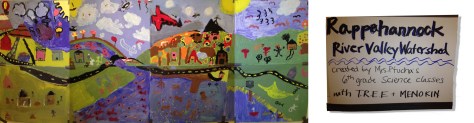 The students of Mrs. Ptucha’s 6th-grade science classes at Richmond County Intermediate School had the opportunity to dive into the Chesapeake Bay Watershed recently – with paint and brushes. The students participated in a Project WET activity, Make-a-Mural.
 identify their local watershed and illustrate it, including water resource
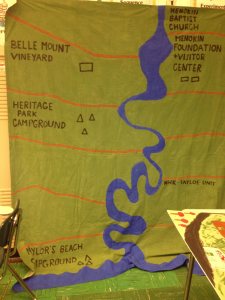
 the students were then asked to begin on the mural. Using foam core panels, and acrylic paint, each student worked on designated portions of the watershed – air, land and water.
 and is hanging in the hallway at the school.


