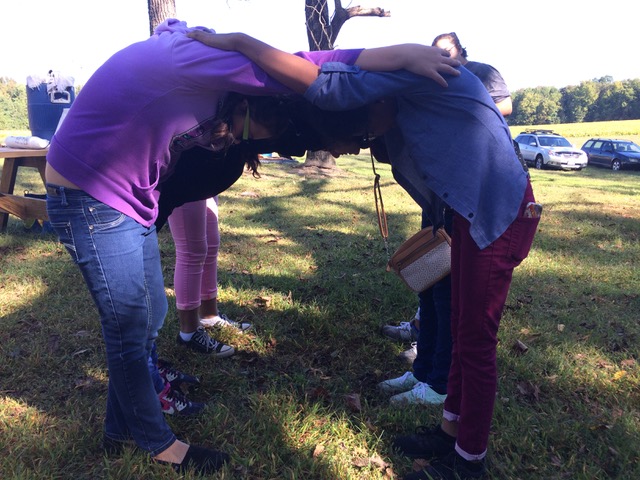
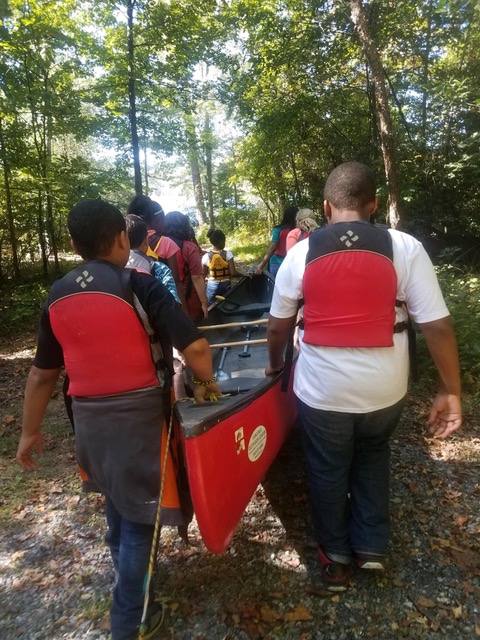
This month, students from Essex Intermediate visited Menokin to learn why cultural institutions like ours are part of the Rappahannock River Valley Watershed. This is more than a STEM program, and a state initiative to give every 6th grader a MWEE, “meaningful watershed educational experience” it’s STEAM: Science, Technology, Engineering, Arts, (or Architecture as we like to say) and Math. And at Menokin, we demonstrate these important ways of learning every day.
STEArchitectureM – Human StairsSTEArchitectureM – Human Arch
Students get to visit the site and have a real water experience in a canoe on Cat Point Creek; walk the trails and learn about this special habitat; take a Hard Hat Tour and learn about the cultural history of this property, and it’s relationship to where they live.
Heading out on Cat Point Creek.
Why is Menokin involved in a program about watersheds? Because our site has a history that goes back thousands of years. Did you know that, while our continents were forming, and waterways and mountains being created, that Menokin was always on high ground? People have lived here for a long time because of its rich natural resources, that have always made it a desirable place to live.
ScienceTArtM: Grinding soil pigments.ScienceTArtM: Painting with soils.
Our house is a couple of hundred years old, yet the high-ground of our landscape is thousands of years old and inhabited my many for thousands of years before English settlers ever arrived. Our house may be the largest artifact we have of recent cultures, but our ground is deeply embedded with the cultures of many before Captain John Smith ever arrived. Yet, he carried on the identity and heritage of the Rappahannock Tribe, by using their word for this special place, Menokin, which we still call it today, in the 21st century .
Menokin, a 500 acre classroom connecting the past to the present. Come visit for yourself, connect with your world, and be inspired.
I have been struggling to formulate the “official Menokin blog post” about the Menokin Sleepover Conference. We have heard from others: blog and facebook posts; tweets and instagram stories.
This morning it occurred to me that the trouble was that I was trying to write from Menokin’s perspective instead of my own. With that clarity, I decided that instead, I will share my personal journey through the process of understanding white privilege and how it led me to the truths of the weekend’s conversations.
Let me confess that until very recently, I had never really given the concept of white privilege a second thought. How very white privileged of me! So it will not come as a surprise that it had also never occurred to me, until Michelle Obama gave vocal credit, that enslaved people had built the White House.
Duh!
Of course they did. The landed gentry of the 18th-century certainly weren’t out in the woods felling trees and turning them into construction timbers and beautifully carved panelling. They weren’t burning their hands baking bricks, or sweating over a hot fire forging nails and hinges.
This dentil molding has stood the test of time and the stress of several journeys.
The hidden work of the builders is exposed at Menokin. Here chisel marks tell the story of fitting the front door assembly into a stone opening.
Hand-carved molding exhibits the level of craftsmanship that was available at Menokin.
Hand-carved raised panel door and hand-wrought hinge.
Grain of the long-leaf pine used for the woodwork.
Their unpaid, enslaved laborers did that work. At the White House, and in Colonial Williamsburg, and at all the grand plantation homes that are so revered as part of our national history. Including Menokin.
Fingerprints captured forever in bricks still warm from baking.
Joe McGill places his hand in the indentations.
Joe McGill and Lauranett Lee search for more fingerprints in the chimney bricks.
This hat has more stories than I will ever get to hear.
Hand wrought nails.
The evidence is everywhere. These people were makers. They made houses and bricks. They made nails and hinges. They wove fabric and spun wool. They grew crops and cooked meals for their owners while their own families often went hungry.
I am a maker. I paint and draw. I knit and needle felt. I take pictures. I cook. And I love to share my accomplishments with my friends and family. I enjoy the appreciation of the work I have created with my own hands.
So when I started to really think about the Makers of Menokin and how their voices were silenced, their children sold, their lives and work unappreciated, their history UNTOLD — I got mad.
And the more I think about it, the more I understand today’s anger. We ALL want to be proud of our accomplishments. We all want to share a very personal part of ourselves and be told how beautiful our creations are. We all want to be valued.
When I lead visitors through Menokin now, I share my white-privileged revelation with them. Many of them are guilty of the same. And together we approach the story with an amended view, by thinking and talking about the enslaved people whose hands shaped and carved and constructed an infrastructure that allowed our “little experiment in democracy” a fighting chance at success.
Frank Vagnone and me shooting selfies at Menokin.
Joe McGill at the Menokin ruin.
The Menokin Sleepover Conference provided a safe place to have a difficult conversation during a tumultuous time. Frank Vagnone and Joe McGill help lead a diverse but eager group through the landmines.
I am proud of our foundation and its good work. And I will forever be grateful for the opportunity to work in a place and with people who are committed to shining a light into the darkness.
Menokin Trustees Tom Duckenfield and Ro King at the Menokin Sleepover Conference.
Last weekend, 23-24 September 2017, I had the fortune to partake in the Menokin Sleepover Conference from the unique perspective of a Menokin Trustee, as well as from the various perspectives of a descendant of Virginia Northern Neck African American slaves, free African Americans, and White slaveholders.
Featuring facilitators Frank Vagnone (One Night Stand) and
Joseph McGill (The Slave Dwelling Project) in their first joint project, the Conference fostered an incredible amount of dialogue and reflection about Menokin, the home of Francis Lightfoot Lee, a Signer of the Declaration of Independence, and his wife, Rebecca Tayloe Lee of Mount Airy Plantation.
After an authentic mid-19th century open-fire meal, Vagnone and McGill facilitated a lantern-lit discussion among the Conference participants about Menokin’s historic inhabitants; its current stewards; its mission, its intrepid melding of colonial architecture and modern glass structural building techniques; and its potential role as a catalyst of racial understanding, reconciliation, and unification.
Following the riveting discussion, several participants and I emulated Vagnone and McGill by pitching tents amidst the Menokin House ruins or in the nearby sward where the former Menokin slave dwellings once stood. At first, my immediate impression was that I was just experiencing a familiar camping-out experience under a clear star-spangled sky, not unlike those of past scouting trips, school outdoor adventures, Army bivouacs, or family mountain getaways.
Tents pitched on the site where Menokin slave dwellings once stood.
As I gazed at the twinkling constellations and reacquainted myself with camping accoutrements, it suddenly dawned on me that this was not an ordinary camping experience at all. Rather, the purpose was to contemplate what it would have been like to be an inhabitant or visitor in a Menokin slave dwelling or in the Menokin House.
Accordingly, via a time and memory conduit constructed by interlacing the “rings” of my family tree with www.ancestry.com DNA dendochronology, I traveled back in time to 1792 — the penultimate year of the second term of Northern Neck son President George Washington – and I began to imagine what several of my Northern Neck ancestors might have been doing then at Menokin.
Portion of Richmond County, Virginia 1818 “List of Free Negroes and Mulattoes” enumerating John Newman, emancipated in 1791 by Robert Carter III.
First, I conjured up the image of my 4th great-grandfather John Newman, who was born a slave in 1770 at Nomini Hall in neighboring Westmoreland County and freed in 1791 by Robert Carter III (1727-1804) as part of the latter’s manumission of more than 500 of his slaves. There are references in peripatetic tutor Philip Vickers Fithian’s Diary about Robert Carter III and his visits to Menokin.
Still savoring his newly acquired freedom, my ancestor John Newman may very well have spent many nights visiting friends and relatives in the Menokin slave dwellings, an example of how many ante-bellum African American families — similar to today’s mixed status immigrant families — had members of mixed free and slave status.
Second, I thought of my fifth great-uncle Moses Liverpool, who was born in 1773 as a slave of Lt. Col. William Fauntleroy (1716 – 1793) on his “Old Plantation” in Naylors Creek, a short paddle ride up the Rappahannock River from Menokin, which is located along the shoreline of Cat Point Creek, a tributary of the Rappahannock River.
Because Moses was described by the Fauntleroy family as “… a very smart, smiling fellow, who is a good cooper, a house carpenter, and ‘a little acquainted’ with the ships’ carpenter business,” I imagined Moses might have spent a few night in the Menokin slave dwellings, perhaps having been hired out to Francis Lightfoot Lee to create or repair Menokin House’s interior woodwork or, alternatively, to build or repair the ships, casks, barrels, and hogsheads used to transport commodities produced at Menokin.
Third, I contemplated how my White slave-holding ancestor Henry Lee III (1756-1818) — my 2nd cousin, 8x removed and known as
Maj. Gen. Henry “Light Horse Harry” Lee.
“Lighthorse Harry” because of his daring in the Revolutionary War — might have spent an evening with his cousin Francis Lightfoot Lee. Henry III’s great-grandfather, Henry Lee I, was a brother of Governor Thomas Lee (1690-1750), the builder of Stratford Hall in neighboring Westmoreland County, Virginia, and Governor Thomas Lee was the father of Francis Lightfoot Lee of Menokin. Henry Lee III married his distant cousin Matilda, granddaughter of Governor Thomas Lee, niece to Francis Lightfoot Lee, and heiress to Stratford Hall.
On the canvas of my mind, I painted a picture of Henry Lee III dining at Menokin in 1792 with his cousin Francis Lightfoot Lee and Francis’ brother Arthur Lee (1740-1792), a physician and opponent of slavery in Virginia, who served as an American diplomat during the American Revolutionary War. I considered that, among other topics, these cousins may have debated slavery and the tension and cognitive dissonance between the institution of slavery and the ideals of the Declaration of Independence, which expresses:
“We hold these truths to be self-evident, that all men are created equal, that they are endowed by their Creator with certain unalienable Rights, that among these are Life, Liberty and the Pursuit of Happiness.”
Taken together, the fervent and introspective discussions of the Menokin Sleepover Conference participants, my own musings concerning how some of my racially diverse ancestors may have inter-related with Menokin, and the social, political, and economic issues revolving around it, Menokin occupies a singularly unique position.
Menokin can not only be the focal point and catalyst for preserving and rebuilding a national historic landmark, but also be the focal point, catalyst, and host of future conferences – a la the Aspen Institute — to foster discussions that can promote understanding and reconciliation to dissipate the long shadow of slavery by actualizing the shining ideals of the Declaration of Independence signed by Francis Lightfoot Lee and 55 other American patriots.