Armed with binoculars and embraced by some rare nice weather, members of the local Audubon Society chapter met with Alice at Menokin on April 3rd.
The purpose of the visit was to orient themselves with the trails and get a feel for the number and types of species available here for birding enthusiasts.
Menokin is situated in the Atlantic Flyway, which is a migratory route for many species. From the forests of New England, where birds like the Wood Thrush nest and breed, to the beaches and marshlands that stretch down the coast and provide habitat for Piping Plovers and Saltmarsh Sparrows, Audubon is employing tactics as diverse as this flyway’s ecosystems to protect the millions of birds that depend on this flyway.All migratory birds depend on healthy nesting grounds, healthy migratory stopover sites, and healthy wintering grounds. Audubon’s work with forest owners in the eastern United States is helping to ensure that dozens of birds have the habitat that they need to raise their young successfully. Their work to protect urban parks and coastal migrant traps and to reduce building collisions along the heavily urbanized Atlantic seaboard is helping maintain safer migratory pathways, and their growing partnerships in the Caribbean and Central America will help us protect the winter homes of these birds too.
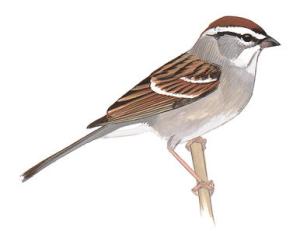
Fifteen species were identified during the one-hour Menokin bird walk. Here is the list. Each picture links to complete species information and various recorded bird calls. Enjoy!
Earlier that afternoon, some of Menokin’s Trustees were on hand to greet Dr. Dunn and his family as they arrived from a previous engagement in Charlottesville. Sarah Pope, Executive Director, made a brief presentation about Menokin and it’s revolutionary preservation plan to conserve and interpret this National Historic Landmark.
Guests, staff and trustees mingled with the Dunns, giving them a taste of Northern Neck hospitality, and some personal insights into the Glass House Project.
Dr. Dunn and his wife, Mary Maples Dunn, are greeted by Sarah Pope, Executive Director of Menokin.
Even Dr. Dunn could not resist the charms of Helen Murphy, former trustee of Menokin.
Sarah gave an overview of Menokin’s bold plan.
Tayloe Murphy, Foundation President, spoke with Jim Rogers and Beverly Rowland.
Trustee Rosemary Basile King explains the Menokin landscape to Tod and Barry Salisbury.
Then it was off to RCC. People came from far and near to attend the lecture. With space at a premium, many arrived early to get a good spot. The auditorium was full to capacity, with an overflow room taking those who were unable to make reservations.
The lecture wrapped up with a Q&A from the audience and a book signing.
Dr. Richard S. Dunn
Shout out to RCC for being such a generous and helpful host.
A capacity crowd with a live feed to an overflow room.
Guests lined up to purchase the book and made donations to Menokin.
Dr. Dunn was a trooper and signed many, many copies!
Guests then attended a lovely reception hosted by Catherine and Tayloe Emery at nearby Mount Airy. Because Mount Airy and owner John Tayloe III were a focus of the book, it felt most appropriate for attendees to gather there to engage and be inspired.
Sarah Pope (l) and Catherine Emery (r) at the Mount Airy reception
Looking toward the carriage entrance from the porch at Mount Airy.
Gwynne Tayloe of Mount Airy discusses the portraits in the great hall with the Dunns.
Tod and Barry Salisbury enjoyed the evening.
Menokin staff Mavora Donoghue (l) and Alice French (r) enjoyed relaxing with Trustees Ro King (2l) and Penelope Saffer (2r).
The lecture was video-taped and I’ll be sure to post a link to you tube as soon as it’s ready to share.
This program has been organized by the Virginia Museum of Fine Arts and is supported, in part, by the Paul Mellon Endowment and the Jean Stafford Camp Memorial Fund.
Retired Senior Architectural Historian for the Virginia Department of Historic Resources, Calder Loth, will speak about the significance of the architecture and history of Menokin and other 18th Century Northern Neck homes.
Mr. Loth’s professional credentials include: Instructor in Architectural Literacy for the Institute of Classical Architecture and Art • Member of the Virginia Art and Architectural Review Board • Vice President for the Center of Palladian Studies in America • Member of advisory committees for: Kenmore, Stratford Hall, Gunston Hall, University of Virginia, Battersea, Maryland State House
Return to the Flame or Retreat from the Heat: The New Wheel Order
Wednesday June 24, 2015
2:00 – 4:00 pm
The New Wheel Order is a restoration and expansion of the notion of function in ceramic art. It involves the consideration of optical warmth as well as optical worth and regards function beyond mere utility. It asks the question, “When does meaning occur,” that is to say the actual experience of art. Does this experience happen in the museum, gallery or the kitchen? There is so much careerism masquerading as education that the salient issues of Craft and Creativity are often elided right out of the conversation. The New Wheel Order is akin to Cezanne’s quest for the truth as he said, “Truth lies not in verisimilitude but in how things are.”
Speaker: Stephen Glass
VMFA Resident Potter Steven Glass will discuss these ideas and conduct a power point presentation of contemporary ceramic art.
Steven Glass has taught pottery at VMFA and other institutions since 1982. He has conducted pottery residencies in Great Britain and Korea and is a member of the board of the Cub Creek Pottery Foundation.
The Grand Tour: “Spring Break” for the 18th-Century Man Wednesday July 29, 2015
2:00 – 4:00 pm
Speaker: Elizabeth Cruickshanks
The Grand Tour: “Spring Break” for the 18th-Century Man For most young men, the Grand Tour, a hallmark coming-of-age trip through France and Italy, was a folly, but for others it was a completely different experience. With the ever-popular Neoclassical movement continuing to take hold in Europe, artists like Benjamin West saw the Grand Tour as an opportunity for inspiration. Take a grand tour through the art and culture of this era and see how the classical past came alive again in 18th-century Britain and France. Art Historian Elizabeth Cruickshanks will lead the program.
Elizabeth Cruickshanks earned both an MA in the History of Art & Architecture and a BA in Art History at the University of Virginia in Charlottesville, Va. Her Master’s work concentrated on the art of 18th-Century Europe. Ms. Cruickshanks worked in the Department of Art & Education at the Virginia Museum of Fine Arts for almost five years, and currently serves as a VMFA Statewide Speaker on the Arts.
Face Value: Portraiture in American Art Wednesday August 26, 2015 2:00 – 4:00 pm
Portraiture in American art ranges from folk to classical and from realism to impressionism. Delve into these stylistic variances with a visual exploration of painted portraits of Americans by Americans. Explore works in significant portrait collections across America, including the Metropolitan Museum of Art, the Pennsylvania Academy of Art. and the Virginia Museum of Fine Arts.
Speaker: Margaret Hancock
Margaret Hancock holds her M.Ed from the University of Virginia and her B.A. in Art History from Duke University. She owns and operates Margaret Hancock Studio, curating art exhibitions and educational programming for a variety of institutions. Margaret is the former Director of Programs and Curator for the Virginia Center for Architecture. Her resume also includes the Savannah College of Art and Design, the National Trust for Historic Preservation, and an internship with the National Gallery of Art.
The Menokin Foundation and Mount Airy bring Historian Richard S. Dunn to the Northern Neck
Friday, March 20, 2015
LECTURE & BOOK SIGNING
3:30 – 5:00
(Copies will be available for purchase)
Rappahannock Community College
Auditorium, Room W122
52 Campus Drive, Warsaw, VA (map)
RECEPTION
5:00 to 7:00
Mount Airy
Mill Pond Road, Warsaw VA
(map)
Seating is limited to 100. To ensure a space, please RSVP to menokin@menokin.org no later than March 16, 2015. If you need to cancel your reservation please let us know ASAP so that we may offer your space to another guest.
About The Book
A Tale of Two Plantations, a book the New York Times calls “a substantial achievement,” is the culmination of over 30 years of research and describes the differences between the slave societies in the Caribbean and in North America. Dunn compares the lives of enslaved peoples on two massive plantations—Mount Airy in Warsaw, Virginia, and Mesopotamia in Jamaica—and tracks the slave populations on the two plantations in minute detail. At Mount Airy, Dunn focuses primarily on those slaves owned by John Tayloe III, and then his son, William Henry Tayloe, from about 1809 up to the Civil War. An accompanying web site to the book presents mini-biographies of 351 members of four big Mount Airy slave families, including 141 people listed in the 1870 U.S. census. Mr. Dunn plans to emphasize that part of his research in the talk to our Northern Neck audience.
About the Author
Richard S. Dunn is Roy F. and Jeannette P. Nichols Professor Emeritus of American History at the University of Pennsylvania. Among his publications are Sugar and Slaves in 1972; The Papers of William Penn, edited with Mary Maples Dunn, in four volumes published in 1981–1987; and The Journal of John Winthrop, edited with Laetitia Yeandle, published in 1996. He also designed the McNeil Center for Early American Studies at the University of Pennsylvania and was its founding director.
Co-sponsored By: A.T. Johnson High School Alumni Association Essex Public Library Friends Essex County Museum and Historical Society Middle Peninsula African-American Genealogical and Historical Society
Northern Neck/Middle Peninsula Preservation Society Northern Neck of Virginia Historical Society Northumberland County Historical Society
Rappahannock Community College
Richmond County Library Richmond County Museum
Menokin was visited last May by Kurt Repanshek of the National Parks Traveler, Suzanne Copping of the National Park Service and Richard Moncure of Friends of the Rappahannock.
Their mission – paddle along Cat Point Creek and Menokin Bay from Menokin Landing and hopefully find the experience worthy of including in the 2015 Essential Guide to Paddling The Parks.
Click the image for a link to the Paddling Through History article.
Accompanied by Alice French, Menokin’s Intrepid Education and Outreach Coordinator and Bri Basile, summer intern, they determined that it is worthy and they have included a beautiful article about our site and our project in this year’s publication.
Improvements on Menokin’s road, thanks to a generous grant from the National Parks Service Chesapeake Gateways Program, to Cat Point Creek will begin in March and hopefully will be ready in time for prime paddling.
Leedstown Resolutions Sowed Seed of Revolution
by Frank Delano
A spirited sibling squabble will highlight The Northern Neck of Virginia Historical Society’s annual commemoration of the 1766 Leedstown Resolutions on Saturday, Feb. 21, at 10 a.m. at historic Yeocomico Church near Kinsale in Westmoreland County.
The famous resolutions were the first protest of “taxation without representation” and were directed to the British monarchy. The document was a forerunner of the Declaration of Independence ten years later.
This year’s observance will feature interpreters portraying the disparate brothers Philip Ludwell Lee and Richard Henry Lee and their outspoken sister Hannah Lee Corbin — all of whom would have attended Yeocomico Church.
Richard Henry Lee
Richard Henry (1732-1794) was the author of the Leedstown Resolutions. Prior to their signing, he burned effigies of British tax officials at the Westmoreland courthouse. Ten years later, he introduced the bill that became the Declaration of Independence.
Philip Ludwell Lee
Richard Henry’s oldest brother Philip (1727-1775) was no fan of insurrection. He was more interested in the profits from his thousands of acres, his race horses and entertaining his friends at Stratford Hall, which he beautifully renovated and expanded.
Hannah Corbin Lee
The Lee brothers’ sister Hannah (1728-1782) was known as an informed and outspoken activist. After her first husband’s death, she lived happily unmarried to another man to avoid losing property left by her first husband. She was a staunch supporter of the Revolution.
There is no known record of a spirited conversation between these three strong-willed Lees, but it could have occurred after a service at Yeocomico Church or at Hannah’s nearby home. (Their peace-making brother, Francis Lightfoot Lee, would probably have been trying to mediate his hot-tempered siblings!)
Come hear what they might have said about the embers that led to a new country forged in the fire of Revolution.
Yeocomico Church (click image for link to Google Maps)
Yeocomico Church is located at 1283 Old Yeocomico Rd. Kinsale, VA 22488. To reach Yeocomico Church from Cople Highway (Rt. 202) at Carmel Church, take Sandy Point Road (Rt. 604) about two miles north. Turn left on Old Yeocomico Road (Rt. 606) and go a mile to the church. For additional information, contact Steve Walker at 804-472-3291 or yeocomshan@yahoo.com.
Most days are special around here. I’m not just saying that. We get really interesting visitors – of both the human and the wildlife variety. Our work is exciting and fresh and full of potential. And we laugh a lot.
But some days bring a little something extra, and when they do I am compelled to share.
Last week is was Rebecca Ward. Becca’s first grade class had an assignment to send out their “flat” selves to relatives to gather a travelogue of images. You know, Flat Stanley but cuter.
Becca’s Uncle Rob and Aunt Beverly brought Flat Becca to Menokin. They left with these pictures and the newly gained knowledge that Menokin has its own “Becca” (Rebecca Tayloe Lee) to share with their niece.
“Thank you for your hospitality this morning. We sent the pictures of Flat Becca at Menokin to my niece’s elementary school this afternoon. You asked me to e-mail you the pictures that I took. I’ve got 3 photos and one of the letter. FYI, Flat Becca is Rebecca Ward.”– Rob Gates
Contributed by Alice French, Education and Outreach Coordinator for the Menokin Foundation.
What better place to hang out in October than in a cemetery. The Menokin Foundation recently hosted a two day Cemetery Conservation workshop at Menokin Baptist Church in Warsaw, VA. Experts in the field of conservation from the Virginia Department of Historic Resources came out and shared their knowledge of best practices for maintaining, cleaning and documenting stones. It was quite an elucidating experience.
We spent most of our first day in the “classroom” learning about cemetery research and recordation, state laws, archaeology and iconography.
The assembly hall at the Menokin Baptist Church served as a meeting space for the workshop.
Day two was was our “field day” in the cemetery adjacent to Menokin Baptist Church. In addition to studying the iconography on the stones there and learning how to best document and
preserve what remains, there was also clearly noted instruction on the many things NOT to do to a tombstone. Surprise. Most of us were offenders in one way or another.
The main thing I learned is that there is generally very little you can do to forever protect all of the stones in a cemetery. But it is best to try to keep them clear of roots and tree limbs and free of other natural debris. And the ONLY thing you should attempt to clean your stone with is a little bit of ionized water, which luckily for us rural dwellers, is readily available in your local farm supply store. Putting shaving cream and other chemicals may temporarily clean up your stone, but in the long run will hasten its deterioration.
The real key to preserving your site is documentation. Take good photos of what is there. Try to photograph stones to be able to read the text. Then record the information in as many places as you can. DHR has a standard form you can use to gather the most significant information. Also, share your information with other genealogy sites and the church (if your cemetery is associated with one).
This tombstone marks the grave of Richard Harwood and his wife Mary, who died 3 days after him. Inscribed on the stone is this epitaph “They were lovely in their lives and in death were not divided”. The Harwoods owned Menokin during the mid-19th century. Mr. Harwood became a Baptist and deeded land to the Menokin Baptist Church in 1837 for the construction of the church.
The obelisk form is known as a monument. The stone displays many forms of iconography and a lot of the delicate carvings are wearing away, including some morning glories which represent the Resurrection. The urn at the top symbolizes the soul.
For more information about resources about cemetery conservation, please contact the Menokin Foundation at menokin@menokin.org. We’ll be happy to guide you in the right direction.

 (19c) A hinge attached to the back flap of an interior folding shutter that folds inside a casing, as beside a window.
 An ornament consisting of a straight molding with a circular cross section that ends in leafy carving or scrollwork.




 Richard S. Dunn is Roy F. and Jeannette P. Nichols Professor Emeritus of American History at the University of Pennsylvania. Among his publications are Sugar and Slaves in 1972; The Papers of William Penn, edited with Mary Maples Dunn, in four volumes published in 1981–1987; and The Journal of John Winthrop, edited with Laetitia Yeandle, published in 1996. He also designed the McNeil Center for Early American Studies at the University of Pennsylvania and was its founding director.


 Day two was was our “field day” in the cemetery adjacent to Menokin Baptist Church. In addition to studying the iconography on the stones there and learning how to best document and
 best to try to keep them clear of roots and tree limbs and free of other natural debris. And the ONLY thing you should attempt to clean your stone with is a little bit of ionized water, which luckily for us rural dwellers, is readily available in your local farm supply store. Putting shaving cream and other chemicals may temporarily clean up your stone, but in the long run will hasten its deterioration.
 This tombstone marks the grave of Richard Harwood and his wife Mary, who died 3 days after him. Inscribed on the stone is this epitaph “They were lovely in their lives and in death were not divided”. The Harwoods owned Menokin during the