By Alice French: Education and Outreach Coordinator

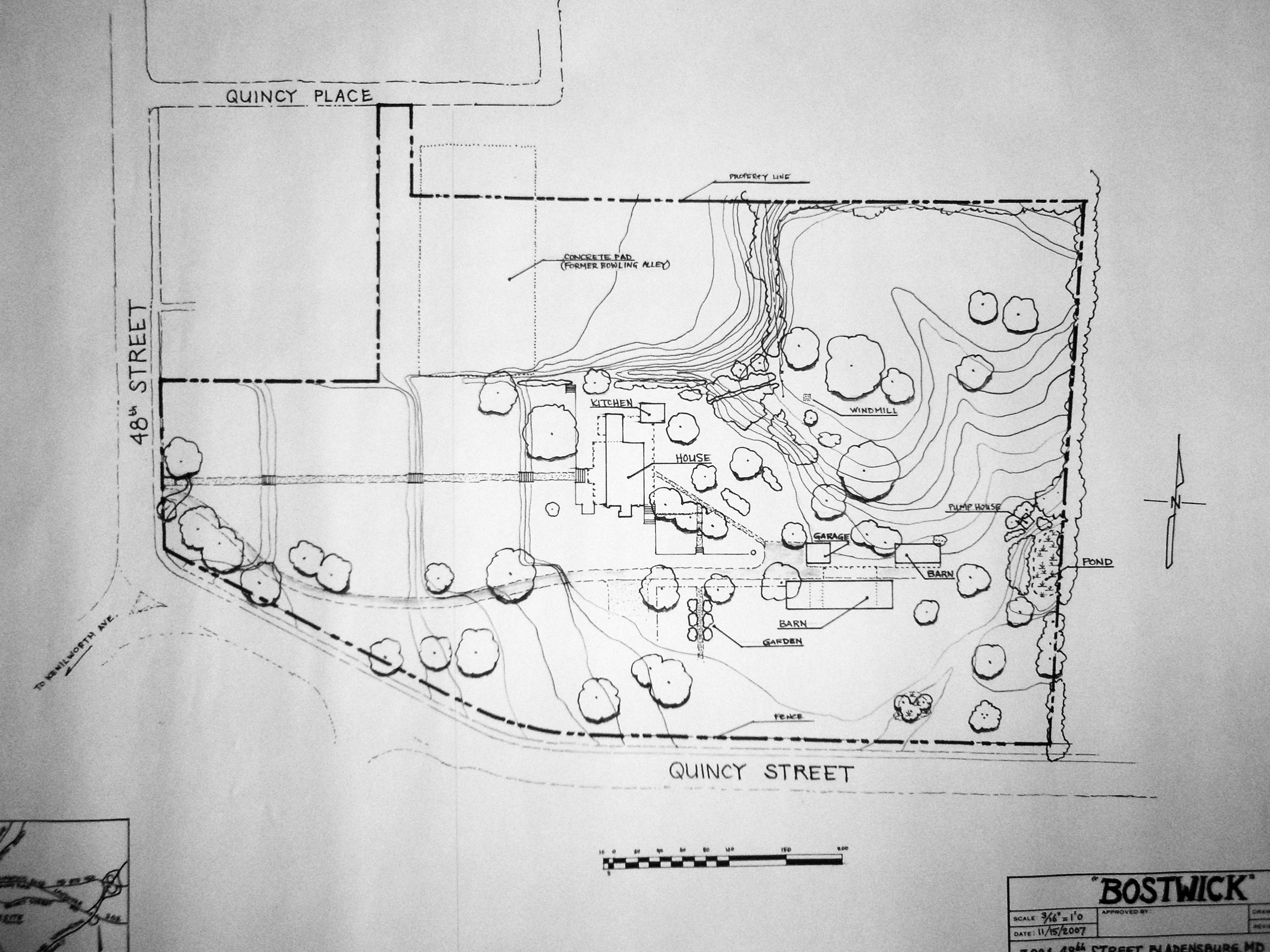
The Bostwick House is a beautiful building located in Bladensburg, MD, built in 1746, by a merchant named Christopher Lowndes. Historicorps currently has crews working on it through October to restore the front porch which had been added on to the house in the early 20th century. As a volunteer for a week, my crew worked on removing old paint from the columns and balustrades.
Previously, a tree had fallen in a big storm, and damaged the corner of the front porch. The storm also damaged a structure which was built as a buttress to the chimney. We needed to get the columns and balustrades scraped, sanded and primed. Some masonry work needed to happen supporting the underside of the porch, and the floorboards and fascia would eventually be tackled as well. Ginny and I began with the scraping work. Sue assisted Mike with some carpentry.
One by one, a column was removed and replaced with a temporary supportive prop. It is hard hand-work scraping paint all day. We had to get suited up in these white Tyvek coveralls to protect us from the paint, along with respirator masks, gloves, boots and a hard hat! Quite the fashion statement. Lunch was served at noon, where we would break for a half hour, remove all of our gear, wash up and eat. It’s really a nice thing that Historicorps serves ALL of our meals- breakfast, lunch and dinner. At 4 o’clock we began clean-up and ended each day by 4:30.


This is my first Historicorps project. Apparently, being provided housing in a building (as opposed to a tent), having indoor plumbing and showering facilities, and a full kitchen are pure luxury compared to most projects! I had no complaints. Also being so close to an urban area, there were plenty of opportunities to go out and eat as well.
A lot of research has been done on the families who lived at Bostwick, and some of the people who worked here. They have an excellent website where you can find all sorts of documentation and resources to learn more: https://bostwickhouse.weebly.com. Coming from my job as an educator at Menokin (www.menokin.org), I am very interested in process, how things are made and who makes them.
From the website I learned, Lowndes imported slaves and sold them in Bladensburg and at the Severn River in Annapolis. He employed indentured servants, convict servants, and enslaved people on his properties and in his businesses. Lowndes enslaved people to work at his shipyard, his ropewalk, the store, at Bostwick House, and at his farms on the outskirts of town. He also posted numerous advertisements in the Maryland Gazette reporting of runaway slaves, “some having stolen items from his store or other businesses.”

I don’t know whether he ever reclaimed his runaway property. Christopher Lowndes was clearly a very wealthy merchant, but with all of his runaways, I imagine he wasn’t the nicest guy to work for. Also, most of the runaways he reported had specific skills such as stonemason, bricklayer, carpenter, plasterer, sailor, shoemaker, rope maker and miller. I am sure they also built this house. One of the special things about doing restoration work is to see and touch the details carved out by the human efforts of these individuals. Evidence of these craftsmen’s skills can be found in details throughout the house and outbuildings.


A later addition to the house was a buttress built to support the 3 story chimney on one end of the house. Stories are rumored that the chamber built inside the buttress was used to house enslaved individuals as punishment.


Documentation doesn’t list where enslaved people lived. They likely lived wherever they worked. “In another advertisement in the Maryland Gazette dated 1760, Christopher Lowndes offers for sale a 480-acre tract of land known as “Good Luck” located five miles from Bladensburg. The land has excellent soil, timber, “a dwelling house, buildings proper for Negroes and two large tobacco barns” (Van Horn 1996:112).” Apparently a dwelling house is not the same as a proper Negro house. Lowndes’ wife Elizabeth, manumitted two of her slaves, Philip Sullivan and Arabella Payne, after her death.
Participating in restoration work and understanding the making of a building is why historic preservation projects are so important. The surrounding community was happy to see work being made on this landmark building. The loss of this place, is a loss of understanding of all of the people who left their marks here. The education and support from preservation organizations involved in this project such as Maryland Heritage Area Authority, Town of Bladensburg Maryland, University of Maryland, George A. & Carmel D. Aman Memorial Trust and Architecture Planning & Preservation are vital to preserving the history of all Americans who built this country. I thoroughly recommend going to the Historicorps website historicorps.com to volunteer for a project or make a contribution.